 FluentSprout
A 15-minute daily language routine that actually works
November 13, 2026 · Updated November 13, 2026
Short answer: fifteen minutes a day, split into listening, speaking, review, and reading or writing, keeps all four skills moving and fits around work and family. Memory research consistently finds that spreading study across days helps you remember more than cramming the same time into one session, and a daily slot is far easier to keep than a long weekly one.
Why do short daily sessions beat occasional long ones?
Two reasons: memory and habit.
Memory. Forgetting starts fast. As early as 1885, Hermann Ebbinghaus concluded that spreading repetitions over time was "decidedly more advantageous" than massing them together. Modern research agrees. A 2006 meta-analysis of 317 experiments found that separating study sessions by at least one day, rather than doing it all at once, was "extremely useful" for long-term memory (Cepeda et al.). A 2013 review of ten popular study techniques gave its highest rating to two: distributed practice and practice testing (Association for Psychological Science).
To be precise, this research compares the same total time, spread out or crammed. It doesn't show that 15 minutes beats two hours. It shows that if you have 105 minutes a week, seven daily sessions will usually serve you better than one Sunday marathon.
Habit. A daily slot becomes automatic. In a well-known study of new daily habits (health habits, not language learning), people took 66 days on average to reach peak automaticity. The range was wide, from 18 to a predicted 254 days (British Psychological Society summary of Lally et al., 2010). Helpfully, missing a single day had little effect. So aim for every day, and don't give up after a slip.
What does the 15-minute routine look like?
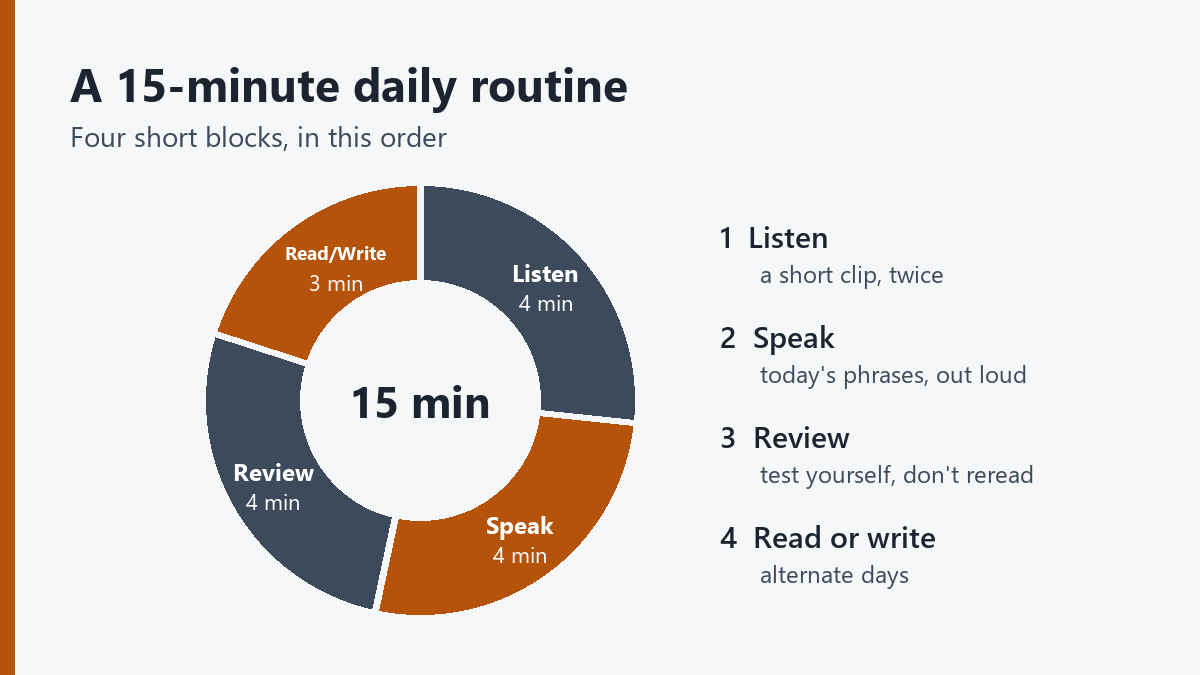
Do the four blocks in this order. Each one sets up the next.
1. Listen (4 minutes)
- Play a short piece of audio at or slightly above your level: a course dialogue, a podcast clip or a news item for learners.
- Listen once for the gist. Listen again and catch three words or phrases you didn't know.
- Beginners: replay one sentence several times until you can hear every word.
2. Speak (4 minutes)
- Say today's new phrases out loud. In memory experiments, words people said aloud were remembered better than words read silently.
- Then talk for one or two minutes using them: describe your morning, retell what you just heard, or answer a question like "What did you do last weekend?"
- Short on privacy? Say the words quietly or just mouth them. The same research found a benefit for mouthing too.
3. Review (4 minutes)
- Go through your due review items: words and phrases from earlier days.
- Test yourself instead of rereading. Look at the meaning, say the word, then check. Retrieval is what the research rates highly. Rereading isn't.
- Add today's new phrases to your review list.
4. Read or write (3 minutes)
- Alternate days. Reading days: a short text at your level, like a graded reader page, a short news item or a social post. Writing days: three to five sentences about your day, or a short message to an imaginary friend.
- Reuse the words from the listening block wherever you can.
How do you adapt the routine to your level?
Complete beginners to A2
- Lean on the review and speaking blocks. Short phrases, said aloud, reviewed often.
- Use course material rather than native media; it's built to match what you know.
Intermediate (B1 to B2)
- Swap course dialogues for real podcasts and articles.
- Stretch the speaking block into timed answers: one minute, no stopping.
Advanced (C1 and above)
- Use the listening block for fast native speech, or shadow it (repeat along with the audio).
- Use writing days for opinion paragraphs, and have them corrected.
Preparing for an exam? Use the same four blocks, but follow the exam's task types: timed speaking prompts, practice questions in the exam's format, and the kinds of writing the exam asks for. See our exam guides.
Is 15 minutes a day enough?
It's enough to make steady progress and keep the language alive, but be realistic about the pace. As a reference point, Cambridge estimates about 200 guided learning hours to move up one CEFR level in English, and calls that a guideline only. Guided hours mean lessons plus supervised study, so they don't convert neatly into solo minutes, but for scale: fifteen minutes a day comes to roughly 90 hours a year. If you have a deadline, such as an exam or a move abroad, treat 15 minutes as your minimum, the session you never skip, and add longer sessions when you can.
How do you make the routine stick?
- Anchor it to something you already do, like your first coffee, your commute or right after dinner.
- Prepare the night before. Have your audio and reading chosen so you don't waste minutes deciding.
- Track the streak, not the minutes. A tick on a calendar is enough.
- Have a two-minute fallback. On terrible days, do only the review block. It keeps the habit alive.
FAQ
Can I split the 15 minutes across the day? Yes. Listening on the commute and review at lunch works fine. Just make sure all four blocks happen.
Should I do more on weekends? If you enjoy it, yes. Use the extra time for something longer, like a film, a conversation or a longer piece of writing, but keep the daily 15 minutes too.
What if I miss a day? Carry on the next day. In the habit study, a single missed day had little effect. Missing many days is what hurts.
Which block matters most? For most self-learners it's speaking, because it's the easiest to skip. Never drop it entirely.
How FluentSprout helps
FluentSprout is an AI tutor for any language, and it fits a 15-minute routine. Structured lessons with checks give you the day's listening and new phrases. Smart review schedules your due items so the review block is ready when you open the app. Speaking practice uses ML speech recognition to check what you said, though no automatic check can judge every detail of pronunciation. You can also practise conversation with the AI tutor by talking or typing, and get feedback on short pieces of writing.
See which languages are ready, or build a course for any language with the AI course builder. The Free for life plan includes every lesson, with a monthly AI-credit limit. Start free.