
Canadian French vs French from France: the differences you'll actually hear
November 18, 2026 · Updated November 18, 2026

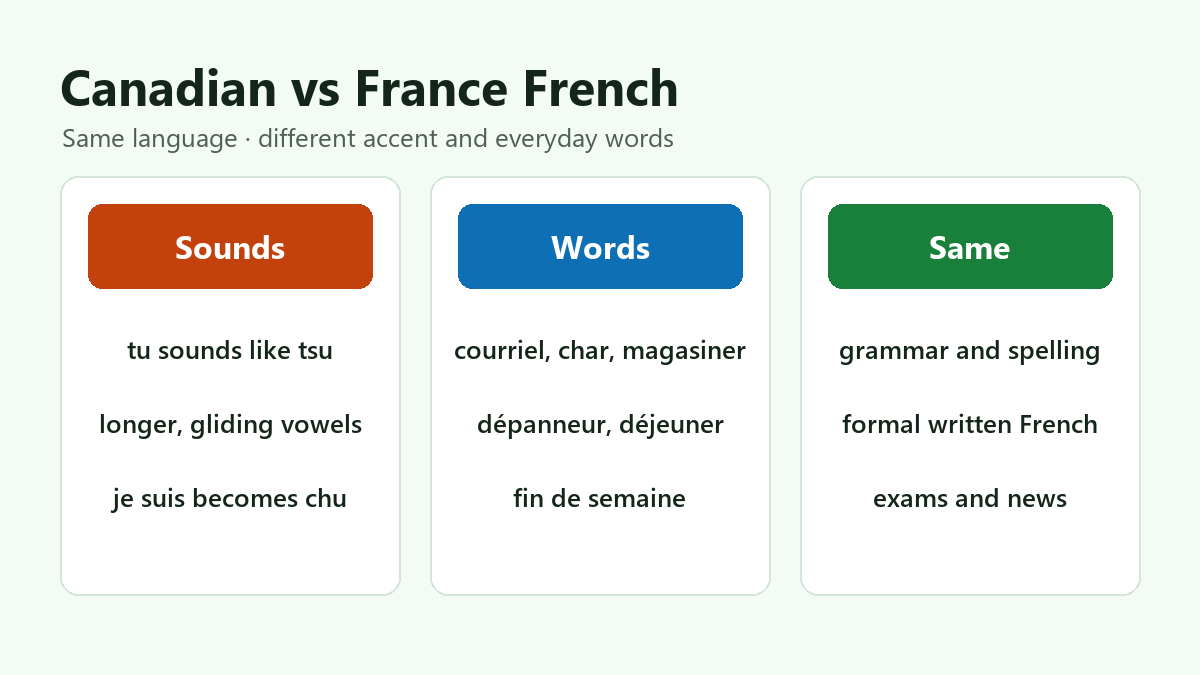
Canadian French and the French of France are the same language. A Montrealer and a Parisian understand each other, read the same books and write by the same spelling rules. What differs is mostly the accent, a set of everyday words and a few habits of casual speech, a bit like American and British English.
The accent
- t and d before i and u. In Quebec, tu sounds close to "tsu" and dire close to "dzire". It's the quickest way to recognise a Canadian speaker.
- Vowels. Long vowels often glide (père can sound like "paère"), and short i, u and ou in closed syllables are more open than in Paris.
- Rhythm. Casual Quebec speech drops sounds freely: je suis becomes "chu", il y a becomes "y'a".
None of this changes the written form. If you learn standard French, you can read any Canadian newspaper.
Everyday words that differ
| Meaning | Canada (Quebec) | France |
|---|---|---|
| courriel | e-mail, mail | |
| to go shopping | magasiner | faire du shopping |
| weekend | fin de semaine | week-end |
| breakfast / lunch / dinner | déjeuner / dîner / souper | petit-déjeuner / déjeuner / dîner |
| car (casual) | char | voiture, bagnole |
| corner shop | dépanneur | épicerie, supérette |
| to park | se stationner | se garer |
| it's cold (casual) | il fait frette | il fait froid |

The meal names catch people out most: in Quebec, dîner is lunch.
Grammar habits in casual speech
- Questions with -tu: Tu viens-tu? ("Are you coming?") is common in casual Quebec speech.
- On instead of nous, as in France, but even more so.
- Fewer English loanwords than France in formal use (courriel, clavardage for chat), and more in casual speech (c'est le fun).

Which one should you learn?
Learn standard French, then tune your ear to the accent you'll live with. Exams such as TEF Canada and TCF Canada use standard French, with recordings that include Canadian voices. If you're moving to Quebec, add an hour a week of Quebec radio, podcasts or TV from the start so the accent is familiar before you arrive.
On FluentSprout, French lessons mark where Canadian usage differs from France, so you learn both words where it matters. See also our page on Canadian French and TEF Canada or TCF Canada?.