 FluentSprout
CEFR levels explained: what A1 to C2 really mean
November 13, 2026 · Updated November 13, 2026
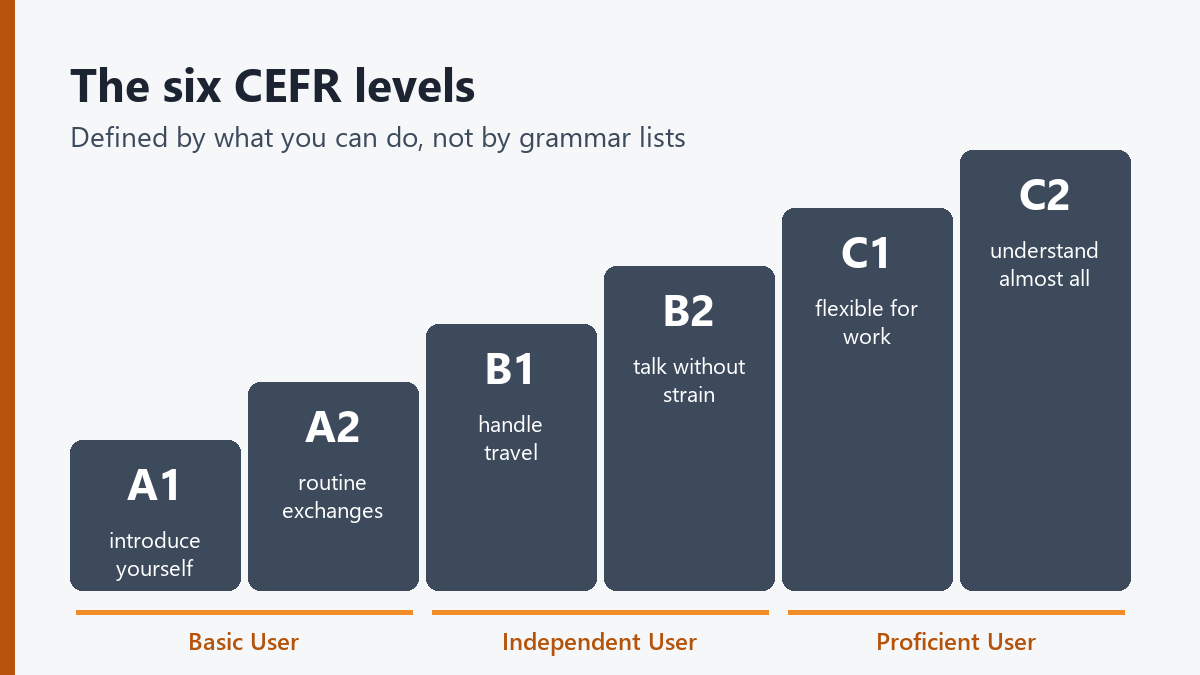
Short answer: the CEFR (Common European Framework of Reference for Languages) describes language ability in six levels: A1 and A2 (Basic User), B1 and B2 (Independent User), C1 and C2 (Proficient User). Each level is defined by what you can do with the language, not by grammar lists. It works for any language, and most major exams report results against it.
What is the CEFR, and who made it?
The CEFR comes from the Council of Europe and was launched in 2001. It organises proficiency into six levels, from A1 to C2, grouped into three broad bands. The levels are defined through "can-do" descriptors: short statements about real tasks, such as introducing yourself or following a technical discussion.
One detail matters a lot for learners: the descriptors were written without reference to any specific language, according to the Council of Europe. That is why "B1" means the same kind of ability in Spanish, Japanese or Swahili, and why you will see the levels on course books, job adverts and university entry rules around the world.
What can you do at each level?
Here is a plain-English summary of the Council of Europe's global scale:
Basic User
- A1: you understand and use familiar everyday expressions and very basic phrases. You can introduce yourself, ask and answer simple personal questions, and get by if the other person speaks slowly and is willing to help.
- A2: you understand sentences about things that matter right now: family, shopping, where you live, work. You can handle simple, routine exchanges and describe your background in simple terms.
Independent User
- B1: you understand the main points of clear, standard speech on familiar topics. You can deal with most situations while travelling, write simple connected text, describe experiences and plans, and briefly explain your opinions.
- B2: you understand the main ideas of complex text, including technical discussion in your own field. You can talk with native speakers with enough fluency that neither side has to strain, and argue a point by weighing pros and cons.
Proficient User
- C1: you understand demanding, longer texts and catch implied meaning. You express yourself fluently without much searching for words, and you use the language flexibly for social, academic and work purposes.
- C2: you understand virtually everything you hear or read, summarise from several sources into a coherent account, and express fine shades of meaning, even in complex situations.
Notice what these descriptions leave out. They don't say "knows the subjunctive" or "knows 2,000 words". The CEFR is about what you can do, and grammar and vocabulary serve that.
Is your level the same in every skill?
Usually not. Many learners read at B1 while speaking at A2, or understand a podcast far better than they can write an email. The CEFR describes listening, reading, speaking and writing separately in its detailed scales, and good exams report each skill separately too.
This is useful for planning. If your reading is ahead of your speaking, more reading won't close the gap. Put your extra time into the weaker skill.
How long does it take to reach each level?
There is no official answer for every language, and anyone who gives you a single number is guessing. The best-known published guideline comes from Cambridge, and it's for learners of English. Cambridge says it takes approximately 200 guided learning hours to move up one CEFR level. Guided learning hours means lessons plus supervised study, not time spent on your own.
Cambridge also gives approximate cumulative hours from complete beginner:
- A2: 180 to 200 hours
- B1: 350 to 400 hours
- B2: 500 to 600 hours
- C1: 700 to 800 hours
- C2: 1,000 to 1,200 hours
Cambridge lists A1 at roughly 90 to 100 hours, linked to its exams for young learners. It calls all of these figures a guideline only. Your background, how intensively you study, your age and how much you use the language outside lessons all change the picture. A language that is far from the ones you already know will usually take longer.
The practical message is that each level takes noticeably longer than the one before. Going from B2 to C1 is a bigger job than going from A1 to A2.
How do language exams map to the CEFR?
Exams relate to the CEFR in two main ways.
1. One exam per level. You pick the level and either pass or fail it.
- The French DELF has four diplomas (A1, A2, B1, B2) and DALF two more (C1, C2). These are official diplomas from the French Ministry of Education, harmonised with the CEFR, as the Université Grenoble Alpes exam centre explains.
- Cambridge English exams are tied to levels too: B2 First, C1 Advanced, C2 Proficiency and so on.
2. One test for everyone, with scores linked to levels. You take the same test whatever your level, and your score is mapped to a CEFR level.
- IELTS is the best-known example. It predates the CEFR, so its bands don't line up exactly with the level boundaries. IELTS says the C1 threshold falls between bands 6.5 and 7, that 8.5 and above counts as C2, and that band 8 is borderline.
Exam providers don't just announce a level. The Council of Europe publishes a manual on how exams should be linked to the CEFR. Even so, a mapping is an alignment, not an exact conversion. If a university or visa rule asks for a level, check which exams and scores that organisation accepts. See our exams pages for format guides.
How do you find out your current level?
- Self-assess against the can-do statements. Read the descriptions above and be honest about the tasks you could actually do today, under real-life pressure.
- Take a placement or practice test in the exam's format. Treat the result as an estimate; only the real exam gives an official result.
- Check each skill separately. Your speaking and writing levels are often lower than your reading and listening.
FAQ
Is B2 "fluent"? B2 means you can talk with native speakers without strain on either side and handle complex topics in your field. Many people call that fluent for everyday purposes, but C1 and C2 go well beyond it.
Can I skip levels? You can sit any level's exam, but the learning itself builds up step by step. Each level relies on the one before it.
Does the CEFR apply to languages outside Europe? Yes. The descriptors aren't tied to any one language, and they are used for many languages around the world. Some exams have their own scales and publish their own alignment to the CEFR.
What do A1+ or B1.2 mean? The Council of Europe says the six levels can be further subdivided to suit local needs, so finer labels like these are used by different schools and courses. Check what a label means to whoever uses it.
How FluentSprout helps
FluentSprout is an AI tutor for any language. Lessons are structured with checks along the way, so you can see what you can actually do, not just what you've read. Exam mode practises in the format of the exam you choose and gives an estimate for each skill. Those estimates help you plan, but they are never official scores. Course depth varies by language, so see what's ready or build your own course with the AI course builder. Look up unfamiliar terms in our glossary.
The Free for life plan gives you every lesson free, with a monthly AI-credit limit. Start free.