
Can you prepare for TEF Canada or DELE with ChatGPT? Where a chatbot falls short
November 15, 2026 · Updated November 18, 2026

"Act as a TEF Canada examiner and mark my essay." It's one of the most common things people type into ChatGPT and Gemini. You get a confident band, a few comments and a nice feeling. Then exam day arrives and the score is different.
General chatbots are useful for exam prep, in a narrow way. They're not built to replace it.
1. The format is only roughly right
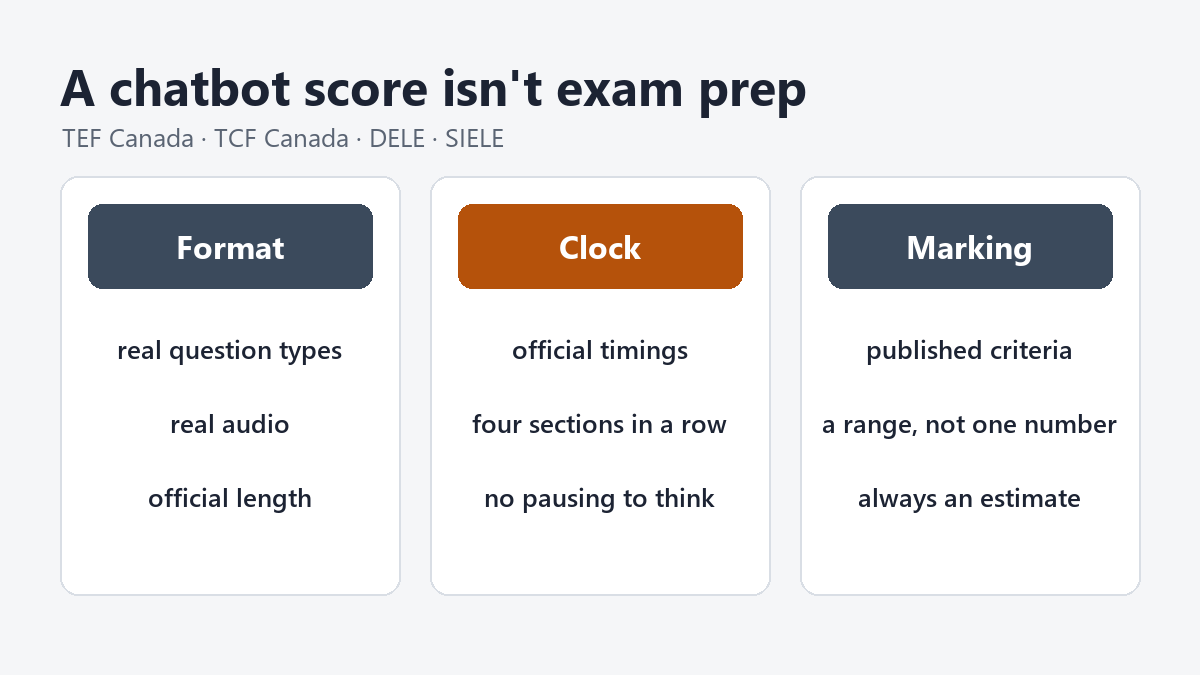
Exams like TEF Canada, TCF Canada, DELE and SIELE have exact formats: how many questions, what kind, in what order, with what kind of audio. A chatbot's "mock" usually looks like the exam from a distance. Up close, the question types drift, the difficulty jumps around, and listening is missing altogether, because a chat window can't play you a real recording at exam speed.
2. There's no clock
Most candidates who know enough still lose points to time. TEF Canada reading is 40 questions in 60 minutes. You need to practise at that pace until it's normal. A chatbot waits patiently while you think, which is the opposite of exam day.

3. The score is a guess presented as a fact
Ask a chatbot to mark your writing twice and you may get two different bands. Push back and the band may go up. It rarely tells you how unsure it is. A single confident number ("You're at NCLC 7!") is the most dangerous thing in exam prep, because it tells you to stop working when you shouldn't.

Honest marking does three things: it follows the exam's published criteria, it shows a range instead of one number, and it says clearly that it's an estimate.
4. It can't see your trend
Exam prep is about trajectory. Are you improving fast enough to reach your target by your exam date? Which of the four skills is holding you back? A chatbot doesn't track your results across weeks, so it can't answer the question that matters most: Am I on track?
5. It doesn't rehearse the day
The real exam is several sections back to back, with breaks you don't control. Being good at each section on its own isn't the same as doing all four in one sitting.
What a chatbot is still good for
- Explaining a grammar point that keeps costing you marks.
- Giving you vocabulary for a topic, such as housing, work or the environment.
- Rewriting a paragraph more naturally so you can compare it with yours.
Use it for those, and get your practice and your marking somewhere built for the exam.
How FluentSprout handles exam prep
- Timed mocks in the exam's format for TEF Canada, TCF Canada, DELE B2 and SIELE reading and listening: a short 12-question version, or full length at the official number of questions and time. Questions follow the format; they aren't past papers.
- Writing and speaking tasks in the exam's format, including TEF Canada sections A and B, TCF Canada tasks 1 to 3, and speaking simulations with the prompt on screen and the official timers.
- Exam-day practice for TEF Canada and TCF Canada: all four sections at the official timings, then one report.
- Marking you can trust more: each answer is marked on the exam's published criteria three times, and the result is shown as a range with the NCLC level it points to. Always an estimate, never an official score.
- A score predictor showing where you are now, where you're likely to be on your exam date, and whether you're on track, at risk or off track, with a plan back from the date.
A chatbot can give you a number. You need to know whether you're ready. Start exam prep on FluentSprout.