
The easiest languages to learn for English speakers (and the hardest), by FSI category
November 15, 2026 · Updated November 18, 2026

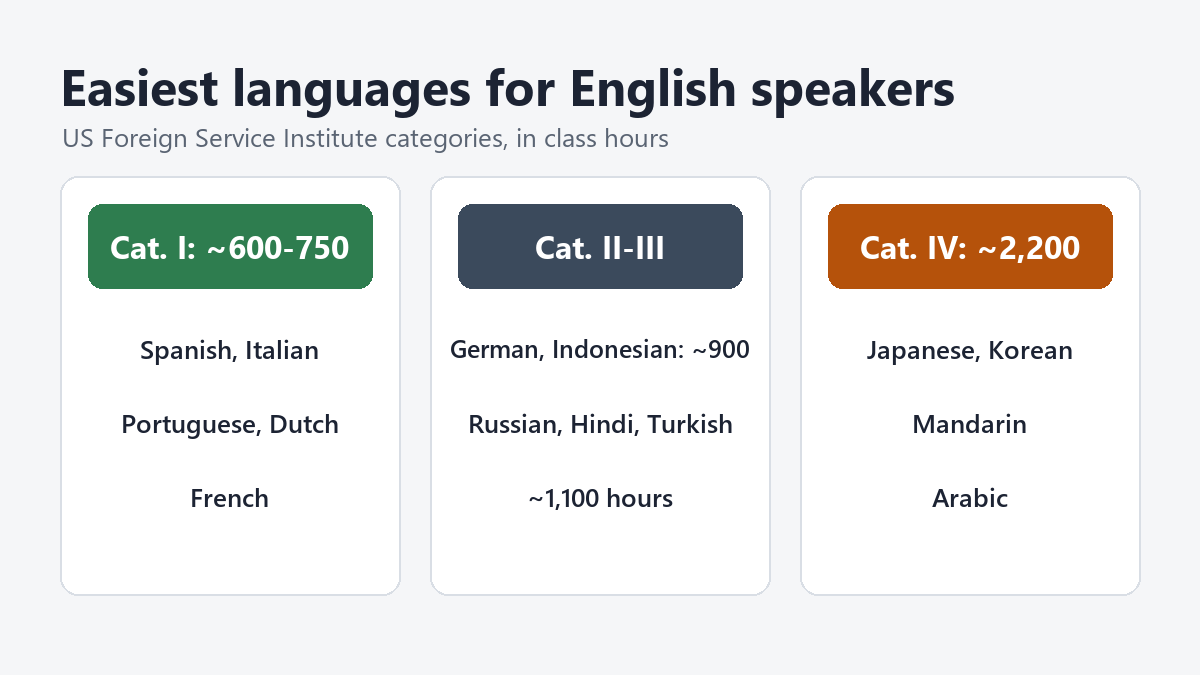
Which language is easiest to learn? If you speak English, there's a well-known answer from the people who train diplomats: the US Foreign Service Institute (FSI). It groups languages into four categories by how many class hours its English-speaking students typically need to reach professional working proficiency.
How to read the FSI list
The hours are for full-time classroom study by motivated adults who are often experienced language learners. Your own time will be different. But the order holds for most English speakers, and it tells you a lot about what you're signing up for.
Key: ✅ supported on FluentSprout (lessons, audio and speech recognition) · 🕒 coming soon · ❌ not offered yet
Category I: about 600–750 class hours (24–30 weeks)
Languages closely related to English, mostly Romance and Germanic.

| Language | On FluentSprout |
|---|---|
| Spanish | ✅ Supported |
| Portuguese | ✅ Supported |
| Italian | ✅ Supported |
| French | ✅ Supported |
| Dutch | ✅ Supported |
| Danish, Norwegian, Romanian, Swedish | 🕒 Coming soon |
| Afrikaans, Catalan, Galician | ❌ Not offered yet |
Why they're easier: thousands of shared words (information, información, informazione), the same alphabet and familiar sentence order. French sits at the top of the range (30 weeks) mostly because of its spelling and pronunciation.
Category II: about 900 class hours (36 weeks)
| Language | On FluentSprout |
|---|---|
| German | ✅ Supported |
| Indonesian | 🕒 Coming soon |
| Swahili | 🕒 Coming soon |
| Malay, Haitian Creole | ❌ Not offered yet |

Why: German shares many core words with English (Haus, Buch, trinken) but adds three genders and four cases. Indonesian has no verb conjugation, no genders and uses the Latin alphabet, but almost no shared vocabulary.
Category III: about 1,100 class hours (44 weeks)
The "hard" languages: real differences in grammar, sounds, script or culture. FSI's list has over 50 of them. Here are the ones our learners ask about most.
| Language | On FluentSprout |
|---|---|
| Russian | ✅ Supported |
| Turkish | ✅ Supported |
| Hindi | ✅ Supported |
| Urdu | ✅ Supported |
| Bengali | ✅ Supported |
| Telugu | ✅ Supported |
| Tamil | ✅ Supported |
| Vietnamese | 🕒 Coming soon |
| Marathi | 🕒 Coming soon |
| Gujarati | 🕒 Coming soon |
| Kannada | 🕒 Coming soon |
| Polish, Greek, Thai, Ukrainian, Czech, Hungarian, Finnish, Hebrew and more | 🕒 Coming soon |
| Persian and others | ❌ Not offered yet |
Malayalam doesn't appear on the FSI's list, but it's in the same family as Tamil, Telugu and Kannada, so expect a similar effort. It's 🕒 coming soon on FluentSprout.
Category IV: about 2,200 class hours (88 weeks)
The "super-hard" languages for English speakers. The FSI assumes about half of that time is spent studying in the country.
| Language | On FluentSprout |
|---|---|
| Mandarin Chinese | ✅ Supported |
| Japanese | ✅ Supported |
| Korean | ✅ Supported |
| Arabic (Modern Standard) | ✅ Supported |
| Cantonese | 🕒 Coming soon |
Why: new writing systems (thousands of Chinese characters; Japanese mixes three scripts), tones in Mandarin, very different grammar, and almost no shared vocabulary. Japanese is flagged as usually taking longer than the others.
"Hard" doesn't mean "don't"
Hours are an average, not a sentence. Millions of people learn Japanese and Arabic as adults. What makes the difference is steady daily practice in the right order, which is exactly what a tutor is for.
On FluentSprout every lesson goes Learn, Practise, Check, so nothing gets skipped. You speak from day one with corrections on every sentence, and new scripts come step by step, with readings shown for every word.
Source
US Department of State, Foreign Service Institute, Foreign Language Training (language difficulty categories for native English speakers). state.gov