
FluentSprout vs Rosetta Stone: the CD-ROM era is over
November 15, 2026 · Updated November 18, 2026

If you're over 30, you remember the yellow box. Rosetta Stone was the language course of the CD-ROM era: founded in 1992, sold in airports, the name everyone knew.
That was a long time ago. Rosetta Stone was sold to IXL in 2021 and its method is fundamentally the same as it was in the 1990s: look at pictures, match them to words, never translate, never explain. In 2026, that's a legacy product.
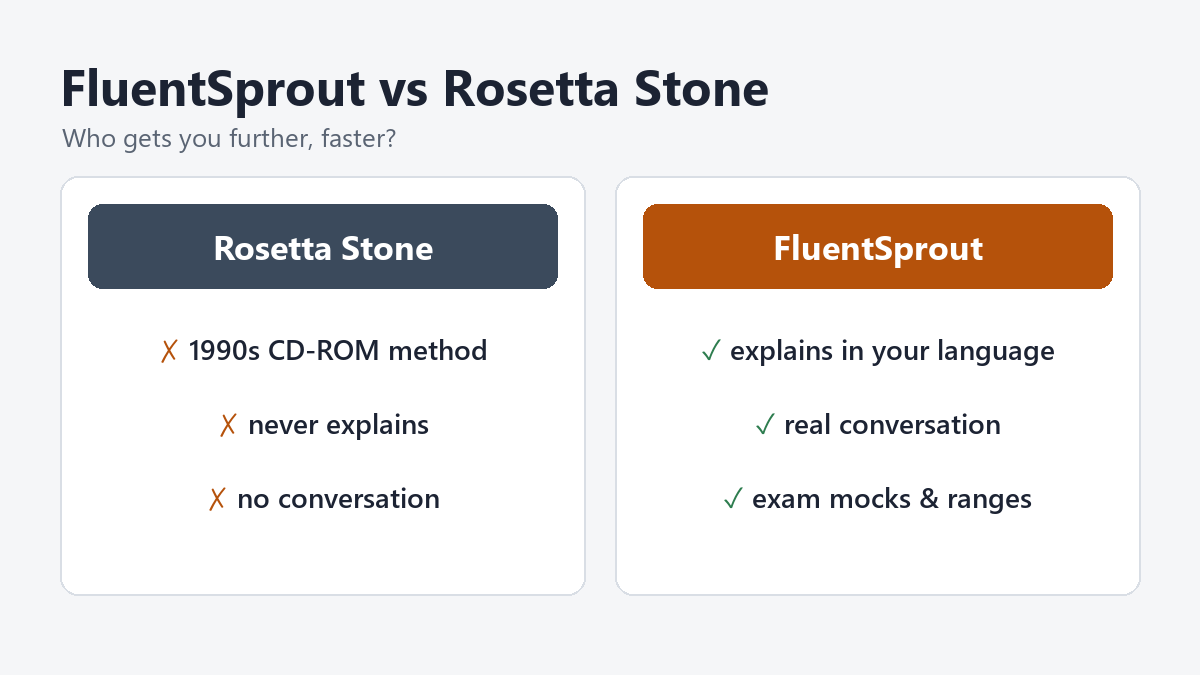
What Rosetta Stone got right (in 1992)
- Immersion. Learn the way a child does, from pictures and context.
- A famous brand with plenty of languages.
Why it's been left behind
- It never explains anything. By design. When you don't understand why it's la and not le, you're left guessing. Adults learn faster when someone tells them why.
- It can't talk with you. Pictures and set phrases are not a conversation. There's no partner who responds to what you say.
- Match-the-picture won't get you through an exam. No timed mocks, no writing marking, nothing for TEF Canada, TCF Canada, DELE or SIELE.
- A method from before smartphones. The world got AI tutors. Rosetta Stone got a new owner.

Why FluentSprout is what language learning looks like now
- Learn like a child, with a teacher's help. Sounds, words, phrases, then grammar, plus Ask the tutor, which explains in your own language whenever you're stuck.
- A real conversation partner. Talk about anything at your level and see every sentence corrected.
- Speaking feedback. Repeat after me shows which words came through and which didn't.
- Exams covered. Timed mocks, exam-day practice and a predictor that tells you whether you're on track.
- Real-life rehearsal, from renting a flat to a job interview.

The verdict
Rosetta Stone is a piece of language-learning history. FluentSprout is where it's going. Leave the yellow box in the 1990s.
Details about other apps are as we understand them in November 2026. Apps change, so check their own sites too.