
Full-length TEF Canada and TCF Canada mock exams: real question counts, real time
November 18, 2026 · Updated November 18, 2026

Twelve questions tell you where you stand. Forty questions against the clock tell you whether you'll last.
On exam day, the hard part of reading and listening is often not one question. It's question 33, when you're tired and the clock says nine minutes left. Full-length mocks let you practise exactly that.
What you get
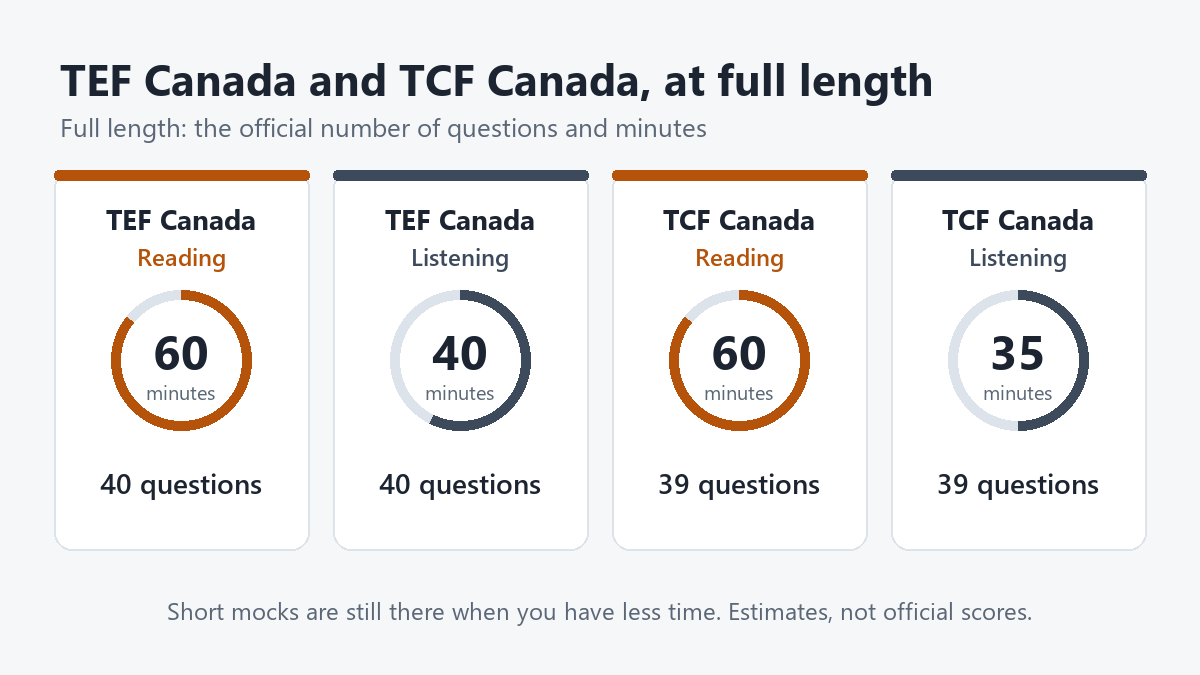
- TEF Canada reading (compréhension écrite): 40 questions, 60 minutes.
- TEF Canada listening (compréhension orale): 40 questions, 40 minutes.
- TCF Canada listening (compréhension orale): 39 questions, 35 minutes.
- TCF Canada reading (compréhension écrite): 39 questions, 60 minutes.
New questions every time, at the official count and the official time. In listening you hear every recording, with a different voice for each speaker, and the transcript stays hidden until the mock is marked, as in the real test. At the end you get your result and an estimate for that skill.
Short or full?
- Short mock: 12 questions, time scaled down. Good on a busy weekday.
- Full mock: the whole section. Do one a week as the exam gets close, and one in the last week at the same time of day as your exam.

A full mock uses more AI credits than a short one. On the free plan that's about three full papers a month, so save them for when they count.
Make it feel like the real thing
- Phone on silent, one sitting, no pausing.
- Paper and pen nearby for listening notes.
- Afterwards, go through every wrong answer before you look at the estimate.

Practice scores are estimates, not official results. FluentSprout is independent and not affiliated with France Éducation international or the CCI Paris Île-de-France.