
How long does it take to learn German?
November 20, 2026 · Updated November 14, 2026
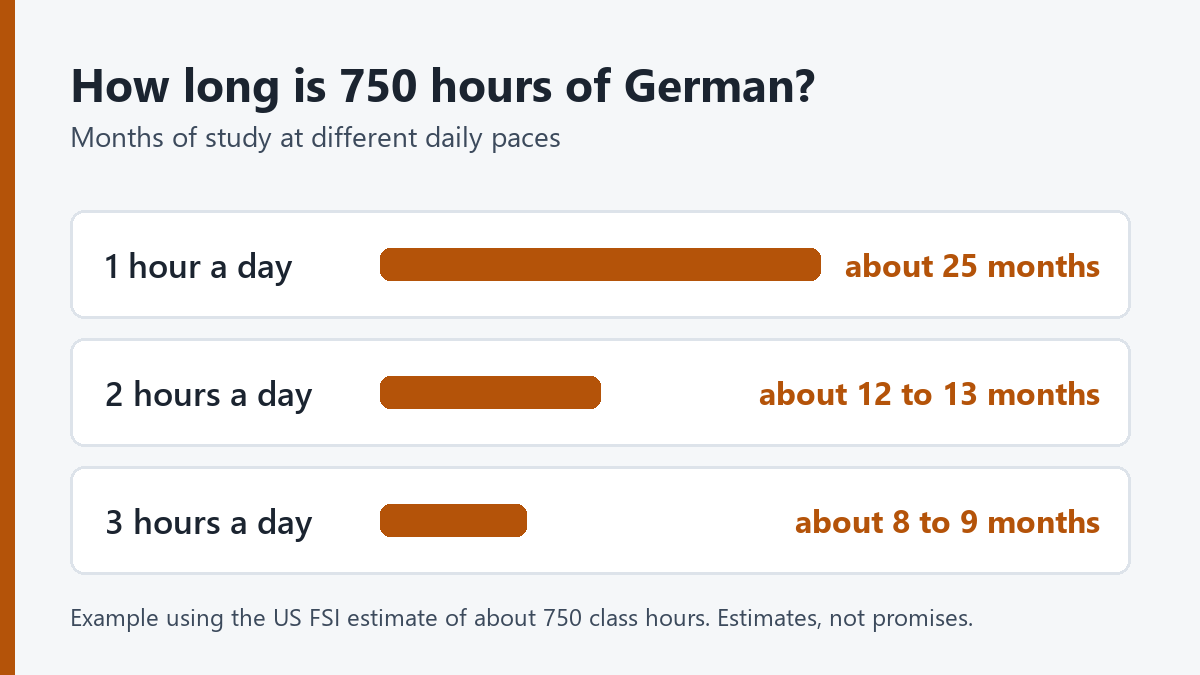
Short answer: for an English speaker starting from zero, an independent level in German (around B2) takes several hundred hours. The US Foreign Service Institute estimates about 750 class hours to professional working proficiency, a little more than Spanish or French. At one hour a day that's around two years; at two to three hours a day, closer to one.
Level by level (rough guide for adults studying regularly)
Typical time from zero, at about an hour a day:
- A1: introduce yourself, ask simple questions, handle basic situations. 1 to 3 months.
- A2: everyday conversations on familiar topics. 3 to 6 months.
- B1: handle most travel and work situations, talk about experiences and plans. 6 to 12 months.
- B2: follow most conversations and argue a point clearly. 12 to 24 months.
Your pace depends on the factors below.
What makes German faster
- English helps. Many everyday words are related: Haus (house), Wasser (water), Buch (book), trinken (drink).
- The spelling is regular. Learn the rules and you can read any word aloud.
- Daily speaking. Say sentences out loud from day one and the grammar sticks sooner.
What makes German slower
- Three genders (der, die, das). Learn every noun with its article from day one.
- Cases (nominative, accusative, dative, genitive) change articles and endings. Learn them in context, not as one big table.
- Word order: the verb comes second in main clauses and goes to the end in many subordinate clauses (…weil ich Deutsch lerne). Strange at first, natural later.
- Long compound words (Krankenversicherung = health insurance) are just smaller words joined together.
A weekly plan that works
- Every day (30-60 min): new words with audio, repeat out loud, review old words, five sentences with today's grammar.
- Three times a week: 10 minutes of slow German listening (learner podcasts, short videos).
- Twice a week: write a few sentences about your day.
- Every few weeks: a short self-test in listening, reading, writing and speaking, to see which skill is lagging.
If you need a certificate
German certificates include the Goethe-Zertifikat (A1 to C2), telc Deutsch, TestDaF (for university) and DSH. Which one you need depends on the visa, employer or university, so check their requirements. See our Goethe-Zertifikat, telc and TestDaF pages.
Learning German with FluentSprout
There's no ready-made German course yet. Build your own with the AI course builder, on the topics you need, and learn it with neural voices and smart review. Speak, and ML speech recognition shows which words came through. Get notified when the German course is ready.
Free to start: start with Google.
Lesson examples are written with AI and checked automatically.