
Québec or Paris? Mexico or Madrid? How different the varieties of major languages really are
November 15, 2026 · Updated November 18, 2026

"Should I learn Spanish from Spain or Latin America?" "Will Parisians understand my Québec French?" "Which Arabic?" These are some of the most common questions learners ask, and the answers range from "don't worry" to "it really matters".
Here's a tour of the major languages: where each variety is spoken, how they differ, how well their speakers understand each other, which one to pick for your goal, and what FluentSprout teaches.
French
Where: France, Québec and the rest of Canada, Belgium, Switzerland, and across West and Central Africa, home to a large and fast-growing share of the world's French speakers.
How they differ:
- Pronunciation: Québec French has its own sounds. Tu and dire sound closer to "tsu" and "dzire", and long vowels can glide. Belgian and Swiss accents are milder variations of European French.
- Vocabulary: in Québec you magasine (go shopping), stationne (park) your car and send a courriel (email), and the weekend is the fin de semaine. Belgium and Switzerland say septante (70) and nonante (90), and parts of Switzerland say huitante (80).
- Formality: tu is used more freely in Québec. Casual Québec speech also has a question particle: C'est-tu correct?
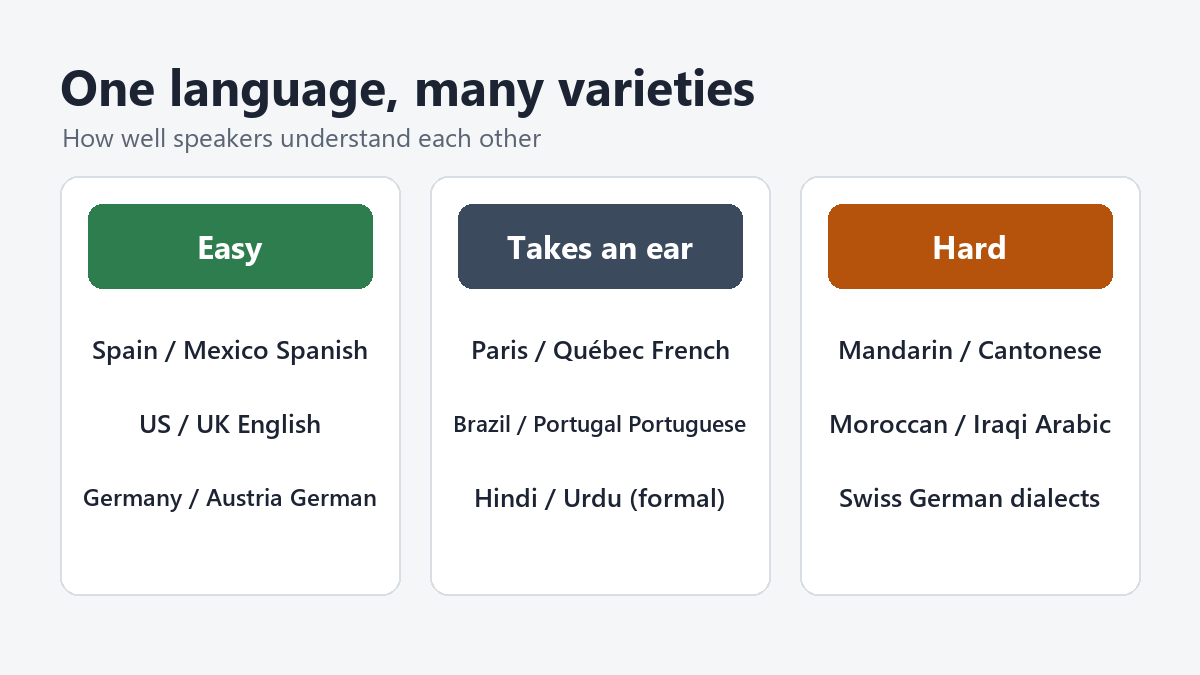
Can they understand each other? In formal speech, the news or at work, yes, easily. Fast, casual Québec speech takes European ears a little time, and the reverse is true too.
Which to learn: standard international French works everywhere. If your goal is Canada (Express Entry, TEF Canada or TCF Canada), learn standard French but train your ear on Québec and Canadian accents too: you'll hear them in daily life, and some exam audio can include them.
On FluentSprout: ✅ standard (France) French as the model, with Canadian French (Québec) differences marked in lessons. Our exam listening library includes many Québec voices.
Spanish
Where: Spain, Mexico (the largest Spanish-speaking country), Central and South America, the Caribbean, and the United States.

How they differ:
- Pronunciation: most of Spain pronounces z and soft c as "th" (gracias = "grathias"). Latin America says "s". Caribbean Spanish often softens or drops final s. In Argentina and Uruguay (Rioplatense), ll and y sound like "sh" or "zh".
- Grammar: Spain uses vosotros for "you all", and Latin America uses ustedes. Rioplatense uses vos instead of tú (vos tenés).
- Vocabulary: a car is a coche (Spain), carro (Mexico, Colombia) or auto (Argentina, Chile). A computer is an ordenador in Spain and a computadora in Latin America.
Can they understand each other? Yes, very well. Differences are like British versus American English, with a stronger accent gap in casual speech.
Which to learn: Latin American Spanish if you'll be in the Americas or the US; Spain's Spanish for Europe. For exams: the Instituto Cervantes exams (DELE and SIELE) accept all standard varieties.
On FluentSprout: ✅ Spain's Spanish as the model, with Mexican and US Spanish variants. Our DELE and SIELE practice follows the exams' international standard.
English
Where: the US, UK, Canada, Australia, Ireland, New Zealand, India, Nigeria, South Africa, Singapore and as the world's main second language.

How they differ: spelling (color/colour), vocabulary (apartment/flat, elevator/lift), and pronunciation: Americans and Canadians pronounce the r in car, while most English speakers in England and Australia don't.
Can they understand each other? Almost always, though strong regional accents can take a while.
Which to learn: whichever matches where you'll live or work. For exams, IELTS accepts either British or American spelling as long as you're consistent, and CELPIP uses Canadian English.
On FluentSprout: ✅ American English as the base, with British and Canadian differences taught. Plus ✅ British, American and Australian accent coaching for people who already speak English.
Portuguese
Where: Brazil (by far the most speakers), Portugal, Angola, Mozambique and other African countries.
How they differ: Brazilian Portuguese keeps vowels open and clear. European Portuguese swallows many unstressed vowels, so it can sound almost Slavic to newcomers. Brazilians say estou fazendo (I'm doing); Portugal says estou a fazer. Brazil uses você widely; Portugal uses tu among friends. African varieties are generally closer to the European norm in writing.
Can they understand each other? Yes, though many Brazilians find European Portuguese harder to follow than the other way round.
Which to learn: Brazilian for Brazil and most online content; European for Portugal and the EU. For exams: CELPE-Bras is Brazil's, and CAPLE is Portugal's.
On FluentSprout: ✅ Brazilian Portuguese as the model, with European Portuguese differences marked.
Arabic
This is the one where the choice really matters.
Where: over 20 countries from Morocco to Iraq and the Gulf.
How they differ: Arabic is diglossic: there are two layers. Modern Standard Arabic (MSA) is the shared written and formal language of books, news, speeches and exams. At home and in the street, people speak regional dialects: Egyptian, Levantine (Syria, Lebanon, Jordan, Palestine), Gulf, Iraqi and Maghrebi (Morocco, Algeria, Tunisia). The dialects differ in pronunciation, everyday vocabulary and grammar.
Can they understand each other? Neighbouring dialects, mostly. Egyptian is widely understood thanks to film and TV. Moroccan Darija is hard for Middle Eastern speakers. Everyone educated understands MSA.
Which to learn: MSA if you want to read, follow the news, work formally or sit an exam. A dialect if you're moving to a specific country and want to chat in the market. Many learners do MSA first, then add a dialect.
On FluentSprout: ✅ Modern Standard Arabic. ❌ Egyptian Arabic and the other dialects aren't offered yet: the voice and speech-recognition technology we rely on doesn't cover them.
Chinese
Where: mainland China, Taiwan, Hong Kong, Macau, Singapore and the global diaspora.
How they differ: "Chinese" is a family. Mandarin is the official language of China (Putonghua) and Taiwan, and one of Singapore's official languages. Cantonese is spoken in Guangdong, Hong Kong and Macau, and has more tones. Wu (including Shanghainese) and Min (including Hokkien) are others. Writing is also split: simplified characters in mainland China and Singapore, traditional in Taiwan and Hong Kong.
Can they understand each other? Spoken Mandarin and Cantonese are not mutually intelligible; they're as far apart as Spanish and Italian or more. Readers of standard written Chinese can largely follow either character set with practice.
Which to learn: Mandarin for almost every goal: business, travel, the HSK exam and the largest number of speakers. Cantonese for Hong Kong or Cantonese-speaking families.
On FluentSprout: ✅ Mandarin with simplified characters and pinyin (currently from beginner to A2). ❌ Cantonese isn't offered yet.
German
Where: Germany, Austria, Switzerland, Liechtenstein, and parts of Belgium, Luxembourg and northern Italy.
How they differ: Austrian German has its own words (Jänner for January, Erdapfel for potato) and a softer sound. In Switzerland, writing uses Swiss Standard German (with no ß), but people speak Swiss German dialects, which even Germans can struggle to follow.
Can they understand each other? Standard German, yes, everywhere. Swiss German dialects, often not without exposure.
Which to learn: standard German, always. Add an ear for Austrian or Swiss usage if you're moving there. Goethe-Institut, ÖSD and telc exams all test the standard language.
On FluentSprout: ✅ Germany's standard German as the model, with Austrian and Swiss differences marked.
Hindi and Urdu
Where: Hindi in northern and central India; Urdu in Pakistan and among Muslim communities in India.
How they differ: in everyday speech, Hindi and Urdu are close to one language (often called Hindustani). The differences are in script (Hindi in Devanagari, Urdu in a Perso-Arabic script) and formal vocabulary (Hindi draws on Sanskrit, Urdu on Persian and Arabic). Compare dhanyavaad and shukriya for "thank you".
Can they understand each other? In everyday conversation and Bollywood films, yes. In news, literature and formal speech, less so.
Which to learn: Hindi for India, Urdu for Pakistan and for Urdu poetry and literature.
On FluentSprout: ✅ Hindi (everyday spoken Hindi, with common Urdu-origin words taught alongside) and ✅ Urdu, as separate courses.
The rest, in brief
- Japanese: standard Tokyo Japanese is understood everywhere; Kansai dialect (Osaka, Kyoto) is the best-known regional variety. ✅ FluentSprout teaches standard Tokyo Japanese.
- Korean: the Seoul standard dominates in South Korea. North Korean usage differs in vocabulary after decades apart. ✅ FluentSprout teaches standard Seoul Korean.
- Dutch: Netherlands Dutch and Belgian Dutch (Flemish) are fully mutually intelligible, with accent and word differences. ✅ FluentSprout teaches Netherlands Dutch with Flemish differences marked.
- Italian: standard Italian is understood everywhere, but many regions also have distinct local languages (Neapolitan, Sicilian). ✅ FluentSprout teaches standard Italian.
- Turkish: standard Istanbul Turkish is the norm. ✅ FluentSprout teaches it.
- Telugu and Tamil: spoken and written forms differ noticeably, and Tamil in Sri Lanka has its own accent and words. ✅ FluentSprout teaches both; the Telugu course uses everyday spoken Telugu with colloquial and written forms marked.
Quick guide: which variety for your goal?
| Your goal | Learn |
|---|---|
| Canada PR (TEF Canada, TCF Canada) | Standard French, with an ear for Québec |
| Moving to Montréal or Québec City | Standard French plus Québec vocabulary |
| Working in the US or Latin America | Latin American Spanish |
| DELE or SIELE | Any standard Spanish, used consistently |
| Reading, news, Arabic exams | Modern Standard Arabic |
| Living in Cairo | MSA plus Egyptian Arabic |
| Business with China, HSK | Mandarin, simplified characters |
| Moving to Switzerland | Standard German, then an ear for Swiss German |
The good news: in every case, the standard variety is your foundation, and it's understood wherever the language is spoken. FluentSprout starts you there, marks the regional differences that matter, and plays you real accents so nothing surprises you.
Sources
- Ethnologue, language and variety entries. ethnologue.com
- Office québécois de la langue française, Grand dictionnaire terminologique (Québec usage such as courriel). oqlf.gouv.qc.ca
- Instituto Cervantes, DELE and SIELE exam information. examenes.cervantes.es
- Real Academia Española and ASALE, Diccionario panhispánico de dudas (voseo, seseo, regional usage). rae.es