
Languages closest to English: the ones your English already half-teaches you
November 15, 2026 · Updated November 18, 2026

If you speak English, you already know thousands of words in other languages. You just don't know it yet.
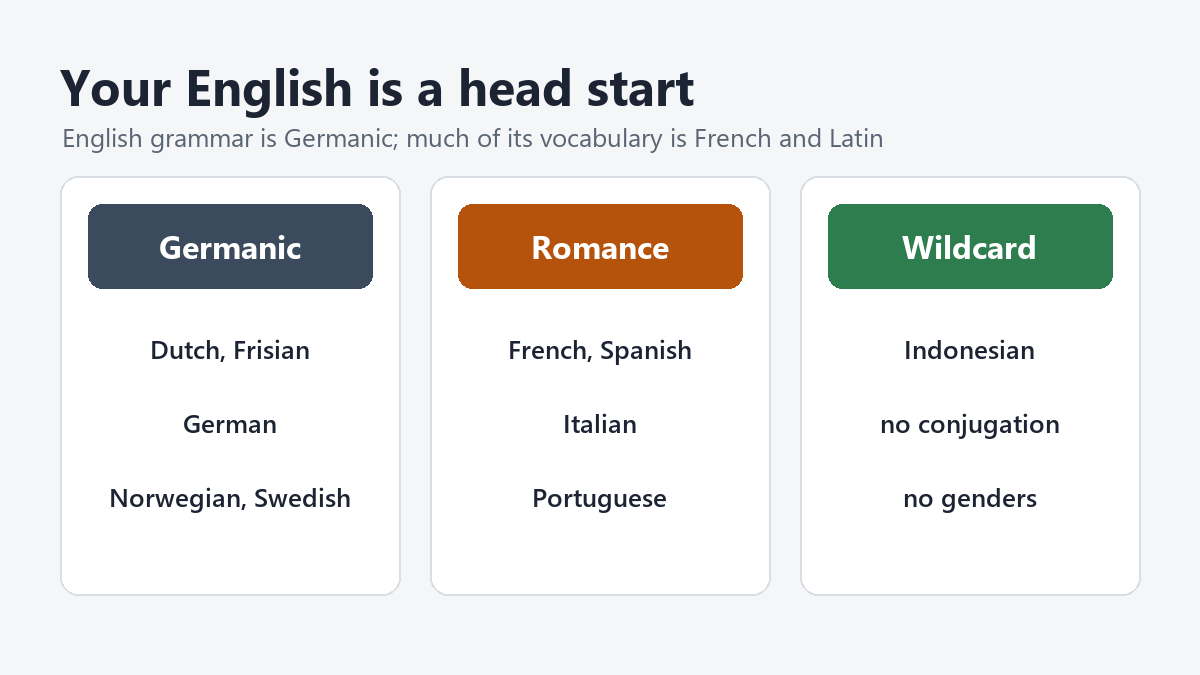
The reason is English's double history. Its grammar and everyday core are Germanic, from the Anglo-Saxons. But after the Norman Conquest of 1066, and centuries of borrowing from Latin, a huge share of its vocabulary became Romance. A classic study of English words (Finkenstaedt and Wolff, 1973) estimated roughly 29% came from French, 29% from Latin and 26% from Germanic sources.
So you get a head start in two directions.
Key: ✅ supported on FluentSprout (lessons, audio and speech recognition) · 🕒 coming soon · ❌ not offered yet
The Germanic cousins: shared grammar and everyday words
| Language | Why it feels familiar | Watch out for | On FluentSprout |
|---|---|---|---|
| Frisian | English's closest living relative: bûter, brea en griene tsiis ("butter, bread and green cheese") | Few learning materials, under half a million speakers | ❌ Not offered yet |
| Dutch | Water, appel, boek, goed; many sentences map almost word for word | The throaty g, and verbs that move to the end of some clauses | ✅ Supported |
| Afrikaans | Dutch-based with very simple grammar: no verb conjugation for person | Mostly useful in South Africa and Namibia | ❌ Not offered yet |
| Norwegian, Swedish, Danish | Verbs don't change for I, you, he; familiar words (hus, bok) | Tones (Norwegian, Swedish) and Danish pronunciation | ❌ Not offered yet |
| German | Haus, Buch, trinken, Finger, Hand; the same core verbs | Three genders, four cases, verb-final clauses | ✅ Supported |
The Romance cousins: shared vocabulary
Thanks to French and Latin, most "educated" English words have close relatives: nation, possible, important, university.

| Language | Why it feels familiar | Watch out for | On FluentSprout |
|---|---|---|---|
| French | The biggest overlap of all: restaurant, gouvernement, intéressant | Spelling vs sound (ils parlent: the -ent is silent), gendered nouns | ✅ Supported |
| Spanish | Words end in -ción (nation → nación); you read it as it's spelled | Two verbs for "to be" (ser, estar), the subjunctive | ✅ Supported |
| Italian | Spelled as it sounds, musical and regular | Double consonants, gendered plurals | ✅ Supported |
| Portuguese | Close to Spanish in vocabulary | Nasal vowels; Brazil and Portugal sound quite different | ✅ Supported |
| Romanian | Latin-based vocabulary | Slavic loanwords and noun cases | ❌ Not offered yet |
Beware of false friends
Shared words aren't always shared meanings. Spanish embarazada means pregnant, not embarrassed. German Gift means poison. French librairie is a bookshop, not a library. A tutor that corrects you as you go saves you a few awkward moments.

A wildcard: Indonesian
Indonesian shares little vocabulary with English, but it's famously friendly: the Latin alphabet, no verb conjugation, no genders and no tenses marked on the verb. The FSI puts it in the same group as German. 🕒 Coming soon on FluentSprout.
Which should you pick?
- Fastest to a conversation: Spanish, Italian or Dutch.
- Most useful worldwide: Spanish or French (and French opens doors for Canada).
- Best for work in Europe: German.
- Best if you already have Spanish: Portuguese or Italian.
Whichever you choose, FluentSprout's lessons go from sounds to words to phrases to grammar, and you speak from day one.
Sources
- Finkenstaedt, T. and Wolff, D. (1973), Ordered Profusion: Studies in Dictionaries and the English Lexicon.
- US Department of State, Foreign Service Institute, Foreign Language Training (difficulty categories). state.gov
- Ethnologue, language family and speaker data. ethnologue.com