
Learn Spanish from zero: a beginner's roadmap
November 17, 2026 · Updated November 14, 2026
Short answer: learn the sounds first (they're regular), then everyday phrases, the present tense, and only then the past tenses. Practise out loud daily, even for ten minutes. The US Foreign Service Institute puts Spanish among the faster languages for English speakers: roughly 600 to 750 class hours for professional working proficiency.
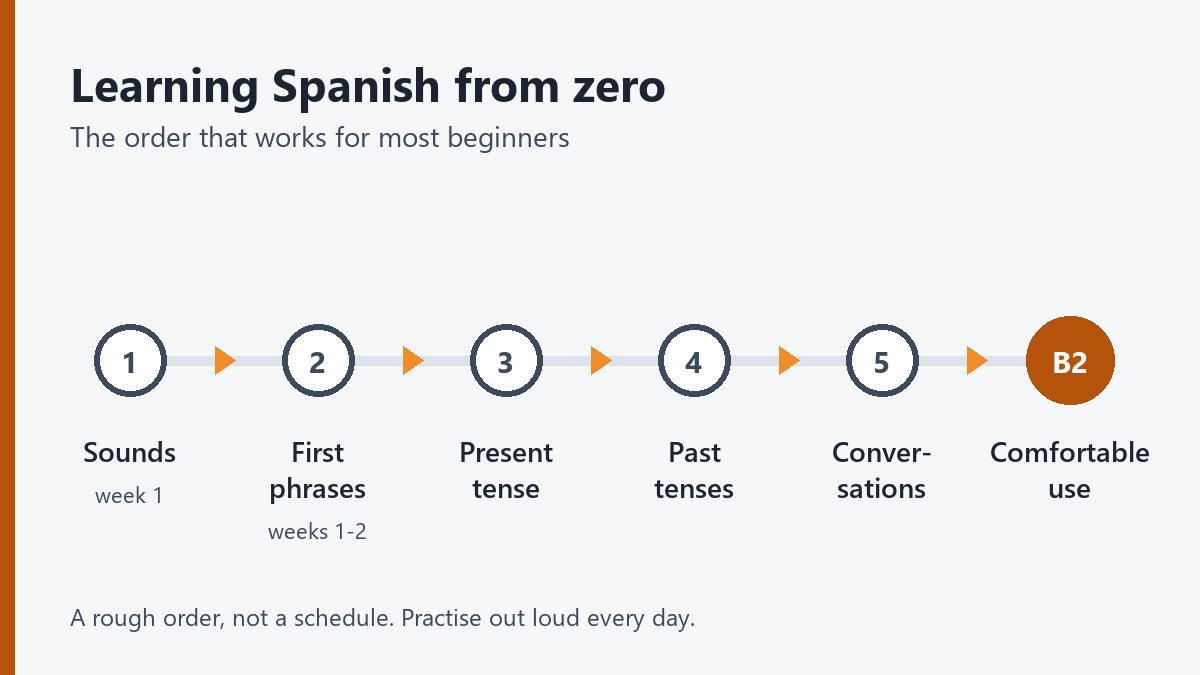
Step 1: the sounds (week 1)
Spanish is spelled the way it sounds.
- Five vowels, always pronounced the same: a, e, i, o, u (casa, mesa, sí, como, tú).
- r and rr: a single tap in pero (but), a roll in perro (dog). The difference changes the meaning.
- ñ as in año (year), like the "ny" in canyon.
- j (and g before e/i) is a breathy sound from the back of the throat: jamón, gente.
- b and v sound the same in most of the Spanish-speaking world.
- h is silent: hola sounds like "ola".
Step 2: first phrases (weeks 1 to 2)
- Hola. Buenos días. Hello. Good morning.
- ¿Cómo te llamas? Me llamo… What's your name? My name is…
- Mucho gusto. Nice to meet you.
- Por favor. Gracias. De nada. Please. Thank you. You're welcome.
- ¿Hablas inglés? Do you speak English?
- No entiendo. ¿Puedes repetir, por favor? I don't understand. Can you repeat, please?
- ¿Cuánto cuesta? How much is it?
Notice the upside-down ¿ and ¡ that open questions and exclamations.
Step 3: the order to learn grammar
- Gender and articles: el libro, la mesa. Learn every noun with its article.
- ser vs estar (both mean "to be"): Soy profesor (who you are) vs Estoy cansado (how you are). Everyone mixes them up at first.
- Present tense of regular -ar, -er, -ir verbs, then the common irregulars (tener, ir, hacer, poder, querer).
- Near future: voy a + infinitive (Voy a estudiar), which gets you talking about plans early.
- Past tenses: the preterite (comí) and the imperfect (comía), then when to use each.
- Later: the subjunctive. Don't rush it; it makes sense once you've heard it a lot.
Spain or Latin America?
Both are correct and understood everywhere. The main differences:
- vosotros (you all, informal) is used in Spain; Latin America uses ustedes for all "you all".
- Many speakers in Spain pronounce c (before e/i) and z like the English "th"; most of Latin America says "s".
- Everyday words vary: coche / carro (car), ordenador / computadora (computer).
Pick the one you'll use most and stick with it. You'll learn to recognise the other by listening.
How long will it take?
It depends on your hours, not your talent. For adults studying regularly:
- A1 (basic survival phrases): a few weeks to a couple of months.
- A2 to B1 (everyday conversations): several months.
- B2 (comfortable, independent use): often a year or more of steady study.
Speaking practice and consistency move these numbers more than anything else.
A daily routine (30 to 45 minutes)
- Listen to new words and phrases, then repeat them out loud.
- Review words from earlier days.
- Build five sentences of your own with today's grammar.
- Listen to five minutes of slow Spanish, even if you understand little at first.
If you need an exam
The two best-known Spanish certificates are DELE (Instituto Cervantes, levels A1 to C2) and SIELE (a single computer-based test that reports a level). See our DELE and SIELE pages.
Learning Spanish with FluentSprout
FluentSprout's Spanish course has 17 lessons so far: six to get you speaking from zero (greetings, your name, the vowels, numbers to 20, colours), eight A1 lessons (ser and estar, articles and gender, present-tense verbs, tener and hay, family, gustar) and a taste of A2, B1 and B2. Every lesson has neural voices and smart review. Speaking checks use ML speech recognition. Heading for DELE B2 or SIELE? Timed reading and listening mocks are in the app. Want more? Build a fuller course on your own topics with the AI course builder. See the Spanish page.
Free to start: start with Google.
Lesson content and examples are written with AI and checked automatically. Spot a mistake? Tell us at support@fluentsprout.com.