 FluentSprout
The shadowing technique: how to do it, step by step
November 13, 2026 · Updated November 13, 2026
Short answer: shadowing means listening to a recording in your target language and saying it out loud at the same time, a split second behind the speaker, like a shadow. Used for short, focused sessions, it trains your ear to catch sounds. Once your listening is strong, it also helps with pronunciation, rhythm and fluency.
What is shadowing, exactly?
A definition by Lambert (1992), quoted by Hamada, says shadowing is "a paced, auditory tracking task which involves the immediate vocalization of auditorily presented stimuli". In plain words, you hear it and say it almost at once. Yo Hamada, a researcher at Akita University who has studied shadowing with learners of English, explains the method in a practical article for teachers. This guide draws on it.
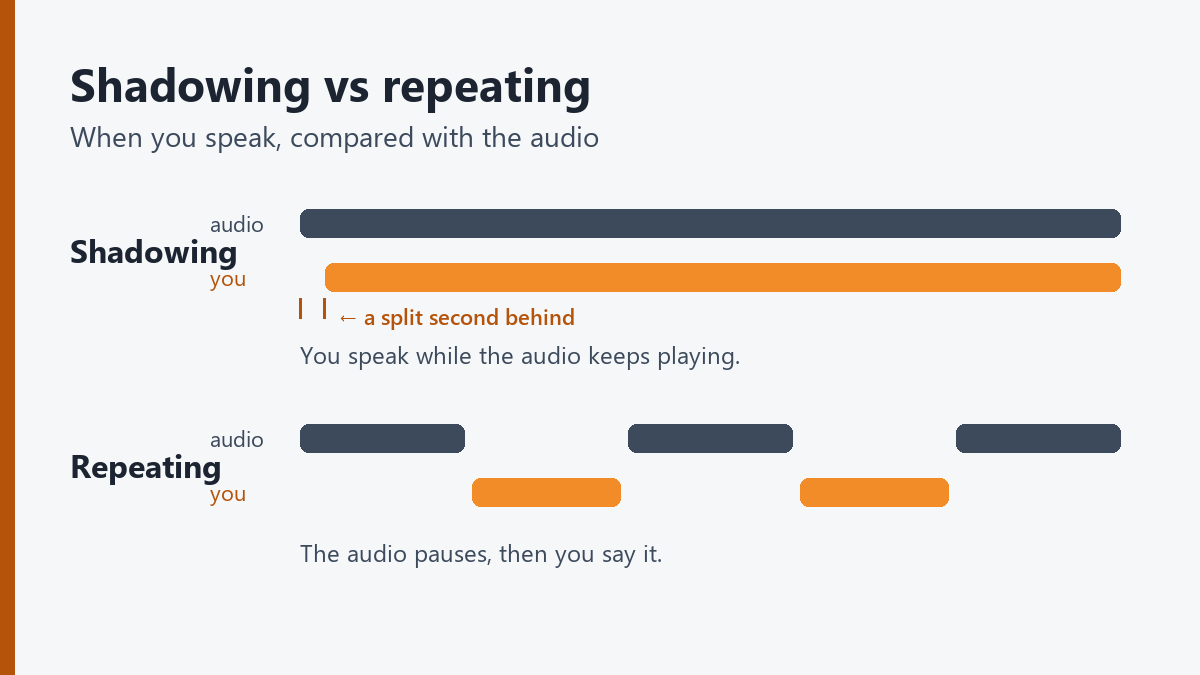
Shadowing is not the same as listen-and-repeat:
- Repeating: you hear a phrase, the audio pauses, then you say it. You usually have time to think about what it means.
- Shadowing: you speak while the audio keeps playing. Nearly all your attention goes to catching the sounds, so you often don't process the meaning as you go.
That difference is the point. Typical listening exercises (listen, then answer questions) train you to guess meaning from context. Shadowing trains the other side: hearing exactly which sounds and words were said.
Why does shadowing work?
Hamada describes two uses:
- Shadowing for listening. Because you must keep up with the sounds, you practise recognising them quickly. With repeated practice, learners get better at catching what they hear.
- Shadowing for pronunciation. To copy a model closely, you have to notice its sounds, stress, intonation and rhythm, then reproduce them right away. Hamada cites a study (Foote and McDonough, 2017) in which advanced learners of English improved their pronunciation and fluency by shadowing TV shows.
There's a catch. Doing both at once is hard. Hamada's rule is: if you can't yet reliably hear the sounds, use shadowing only for listening. Move on to shadowing for pronunciation once your ear has caught up.
How do you shadow, step by step?
- Pick a short recording. Thirty seconds to two minutes is plenty. Use clear audio from a single speaker whose voice you'd like to sound like.
- Understand it first. Listen, read the transcript or a translation, and look up unknown words. Hamada advises knowing the content before you shadow, so your brain is free to focus on the sounds.
- Listen once more without speaking. Notice where the speaker pauses, which words are stressed and where the voice rises or falls.
- Shadow without the transcript. Start speaking a split second after the speaker and keep going. Mumbling is fine at first. Don't stop if you lose a word; pick up again at the next one you catch.
- Repeat across sessions. Hamada reports research finding that about five or six passes of the same passage is enough, and they don't need to be in one sitting. After that, move to a new text.
- Record yourself. Hamada suggests recording your shadowing on a phone so you can check, at your own pace, which words you actually managed to say.
- Keep sessions short. Shadowing is tiring. Hamada cites research showing a noticeable change in listening from two 10 to 15 minute sessions a week for a month.
How should beginners and advanced learners shadow differently?
Beginners and lower-intermediate learners
- Use shadowing to train your ear, not to perfect your accent yet.
- Choose slow, clear audio at or slightly below your level, such as course dialogues.
- Slowing the audio down is fine. Hamada also suggests trying it faster, then going back to normal speed, which then feels slower.
- Focus on keeping up with the sounds. Ignore your accent for now.
Advanced learners
- Use shadowing for pronunciation and fluency. Split your attention between the model and your own voice.
- Choose natural speech: a podcast, a talk or a scene from a TV series you enjoy.
- Record yourself, compare with the original and pick one feature to fix per session: a difficult sound, linking between words, or the melody of questions.
- Match the material to your goal. If you need to follow fast native speech, shadow the fastest audio you can handle.
What are the most common shadowing mistakes?
- Reading along the whole time. Hamada says shadowing while reading is a different exercise, because your attention splits between sound, text and meaning. Use the transcript before and after, not during. (One exception: he describes a variant for pronunciation that uses a phonetic transcript.)
- Shadowing something you don't understand. Trying to decode meaning and copy sounds at once overloads you. Learn the content first.
- Choosing audio that's far too hard. If you lose more than half the words, pick something easier.
- Shadowing another learner. Hamada notes that shadowing a classmate doesn't work for listening practice, because their sounds differ from the target model.
- Doing it for too long. Long sessions lead to tired, careless shadowing. Short and focused is better.
- Never checking yourself. Without a recording, it's easy to think you said words you actually skipped.
- Shadowing one text forever. After five or six passes, move on.
FAQ
Can complete beginners shadow? Yes, as listening practice with very short, slow phrases. Leave accent work until you can hear the sounds clearly.
How often should I shadow? Two or three short sessions a week is a reasonable starting point. Hamada recommends using it intensively for a limited period, then moving on to other practice.
Does shadowing improve speaking fluency? It can help advanced learners with pronunciation and fluency. It doesn't replace real conversation, where you have to choose your own words.
Movies or podcasts? Either, if the speech is clear and you like the speaker. Content you enjoy makes the repetition easier to stick with.
How FluentSprout helps
FluentSprout is an AI tutor for any language. Lessons include audio you can listen to, copy and say aloud. Speaking practice uses ML speech recognition to check whether what you said matches the target words. That's useful feedback, but it can't judge every detail of your accent or intonation, so keep recording yourself and comparing with the original. When you're ready to choose your own words, practise conversation with the AI tutor by talking or typing.
See which languages are ready, or build a course for any language with the AI course builder. Look up unfamiliar terms in our glossary. The Free for life plan includes every lesson, with a monthly AI-credit limit. Start free.