 FluentSprout
Spaced repetition explained: why reviewing later beats cramming
November 13, 2026 · Updated November 13, 2026
Short answer: spaced repetition means reviewing what you've learned at increasing gaps, just as you're starting to forget it, instead of repeating it many times in one sitting. Memory research going back to 1885 shows that spreading reviews over days and weeks keeps words far longer than cramming the same amount of practice into one session.
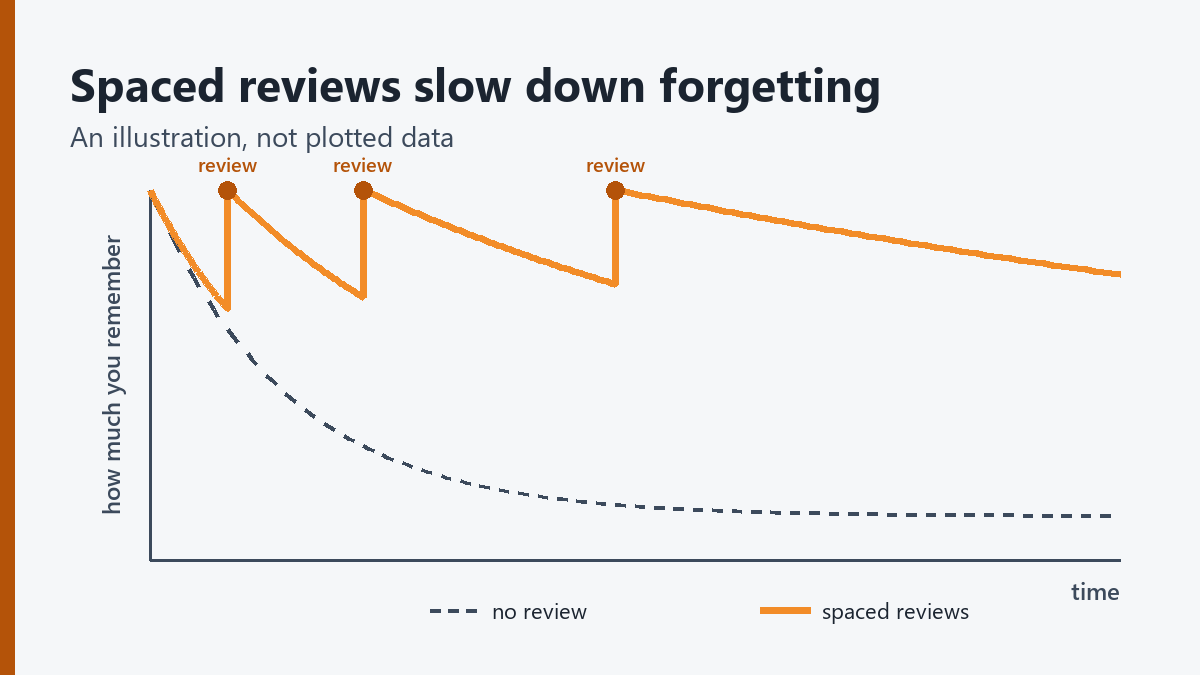
What is the forgetting curve?
In 1885 Hermann Ebbinghaus published his memory experiments (the 1913 English translation is titled Memory: A Contribution to Experimental Psychology). He learned lists of nonsense syllables, waited, then measured how much work it took to learn them again. He called this the savings method: the less relearning you need, the more you've kept.
His results, from his own chapter on retention over time:
- After one hour, only about half of the original effort was saved when relearning.
- After eight hours and after 24 hours, about a third was saved.
- After six days, about a quarter. After a month, about a fifth.
The pattern is the important part: fast forgetting at first, then a long, slow tail. Some caution is needed, though. Ebbinghaus tested only himself, with meaningless syllables. Real words carry meaning and context, so your own curve may look different. Still, the shape has held up: a 2015 replication by Murre and Dros found results similar to the original.
You may have seen claims like "you forget 70% in a day". Ebbinghaus measured relearning effort, not a percentage of words forgotten, so be wary of precise numbers like that.
What is the spacing effect?
Ebbinghaus noticed something else. In a later chapter he concluded that, with a good number of repetitions, spreading them over time was "decidedly more advantageous" than massing them together. This is the spacing effect, and it has been studied ever since: a 2006 review called it one of the mainstays of learning and memory research.
The biggest review of it is a 2006 meta-analysis by Cepeda and colleagues in Psychological Bulletin. It covered 839 assessments from 317 experiments in 184 articles on verbal recall: words, word pairs, facts and passages. Its findings:
- Spacing study sessions apart beats massing them together.
- The best gap depends on how long you need to remember. The longer you need it, the longer the best gap.
- For lasting memory, separating study sessions by at least one day was "extremely useful".
A 2013 review by Dunlosky and colleagues compared ten common study techniques. Two got the highest utility rating: distributed practice (spacing) and practice testing (quizzing yourself). Rereading and highlighting, two of the most popular habits, rated low (Association for Psychological Science summary).
How long should the gaps between reviews be?
A large 2008 study by the same research group taught more than 1,350 people a set of facts, gave a review after various gaps, then tested them up to a year later (Cepeda et al., *Psychological Science*). Two findings are useful for language learners:
- Lengthening the gap first helped, then slowly hurt. Too short a gap wastes the review; much too long and you've forgotten too much.
- As a share of how long you need to remember, the best gap was about 20 to 40% for a test one week away and about 5 to 10% for a test one year away.
Turned into rough guidance:
- Test next week: review again after a day or two.
- Exam in a few months: space reviews out to a week or more.
- Want it for life: keep stretching the gaps over months.
What about gaps that grow each time (expanding intervals) versus equal gaps? The 2006 meta-analysis found expanding intervals did a little better overall, but called the evidence tentative because studies disagreed. Most review apps use growing gaps because they're practical. Don't treat any single schedule as proven.
How do you use spaced repetition for a language?
A common starting pattern is to review new material after about 1 day, 3 days, 1 week, 2 weeks and 1 month. This is a rule of thumb, not a research result. Adjust it to how well you actually remember:
- Got it easily? Make the next gap longer.
- Struggled or missed it? Bring it back sooner, then build up again.
Some habits make spacing work much better:
- Test yourself; don't reread. Look at the word in your language and say or type the target word before you see the answer. Retrieval is part of what makes reviews stick.
- Review whole phrases, not lone words. "Je voudrais un café" teaches more than "café" on its own, and it gives you something to say.
- Say it aloud. Hearing yourself say the word links its sound to its meaning.
- Keep reviews short and daily. Short daily reviews fit spacing better than one long session a week.
- Don't let the pile grow. If reviews are piling up, add fewer new words until you've caught up.
Where does spaced repetition fall short?
Spacing helps you remember words and phrases. It doesn't, on its own, make you fluent. You still need to listen to real speech, speak in real time and write in full sentences. Treat reviews as the base of your routine, not the whole of it.
FAQ
Is spaced repetition the same as flashcards? Not quite. Flashcards are a format; spaced repetition is a schedule. Flashcards reviewed in a cram session aren't spaced. The schedule is what makes the difference.
How many new words should I add each day? There is no research-backed number for everyone. Start small, around five to ten, and watch your daily review load. If reviews take longer than you have, slow down.
What if I miss a few days? Just pick up where you left off and clear the oldest reviews first. You will have forgotten some items. That's normal, and relearning is faster than learning from scratch, which is exactly what Ebbinghaus's savings showed.
Does it work for grammar too? Yes, if you review grammar as example sentences you have to produce, not rules to reread.
How FluentSprout helps
FluentSprout is an AI tutor for any language. Its smart review brings back words and phrases from your lessons at spaced intervals, so you don't have to manage a schedule yourself. Separately, speaking practice uses ML speech recognition to check what you said. It can't judge every detail of pronunciation, so use it alongside careful listening.
See which languages are ready, or build a course for any language with the AI course builder. The Free for life plan includes every lesson, with a monthly AI-credit limit. Start free.