
TEF Canada in 2026: the format, the NCLC 7 scores you need, and how to prepare
November 16, 2026 · Updated November 13, 2026
If you're applying for Canadian permanent residence through Express Entry, French can be worth more than almost anything else you can change about your profile. TEF Canada is one of the two French tests that Immigration, Refugees and Citizenship Canada (IRCC) accepts (the other is TCF Canada). This guide covers what's in the test, the scores you need and how to get there, even if you're starting from zero.
Why French matters for Express Entry
IRCC gives additional Comprehensive Ranking System (CRS) points to candidates with strong French. Reach NCLC 7 or higher in all four French skills and you qualify for the French bonus. The amount depends on your English results, so check the current figures on IRCC's CRS criteria page. On top of the bonus, IRCC runs category-based draws for French-speaking candidates, which have often had lower cut-off scores than general draws.
NCLC (Niveaux de compétence linguistique canadiens) is Canada's scale for French ability. Your TEF Canada result is converted to an NCLC level separately for each skill.
The four sections
All four must be taken on the same day for IRCC to accept the attestation. Results are valid for two years.
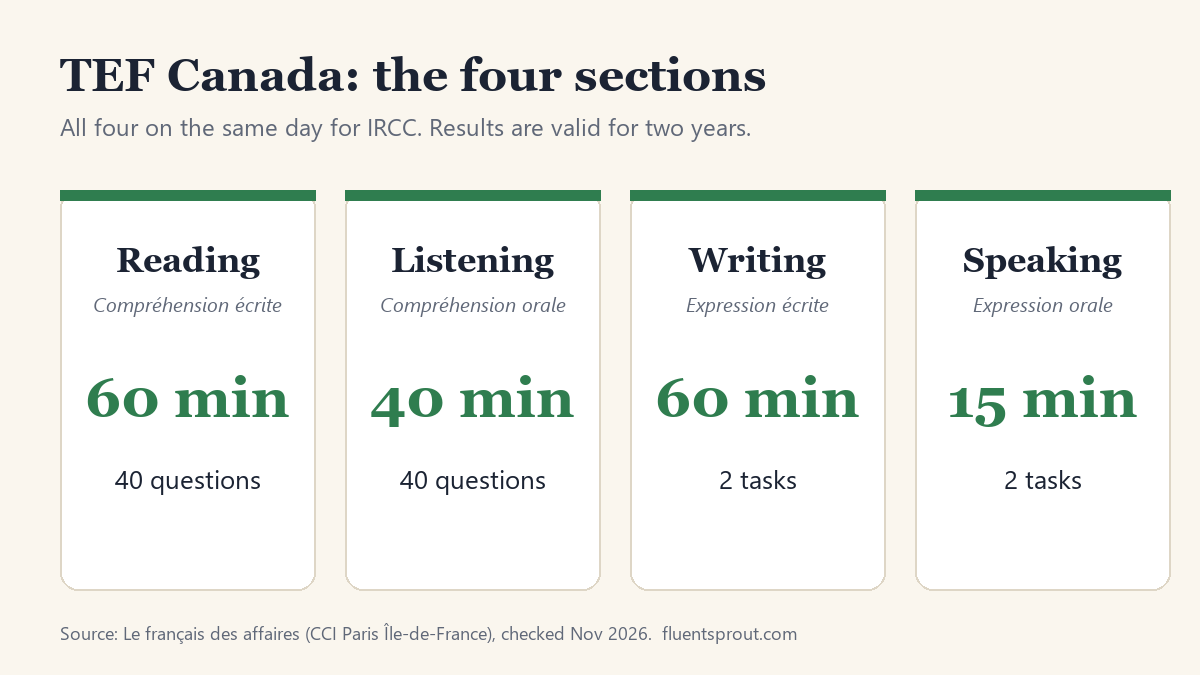
- Compréhension écrite (reading), 60 min: 40 multiple-choice questions on everyday and work texts.
- Compréhension orale (listening), 40 min: 40 multiple-choice questions on recordings, most played once.
- Expression écrite (writing), 60 min: A: continue a short news article (80+ words, 25 min). B: argue your view on a statement (200+ words, 35 min).
- Expression orale (speaking), 15 min: A: phone someone about an advert and get information with about ten questions (5 min). B: convince a friend to take up an offer and answer their objections (10 min).
The scores for NCLC 7
IRCC converts TEF Canada scores using the "équivalence ancien score" scale. The minimums for NCLC 7:
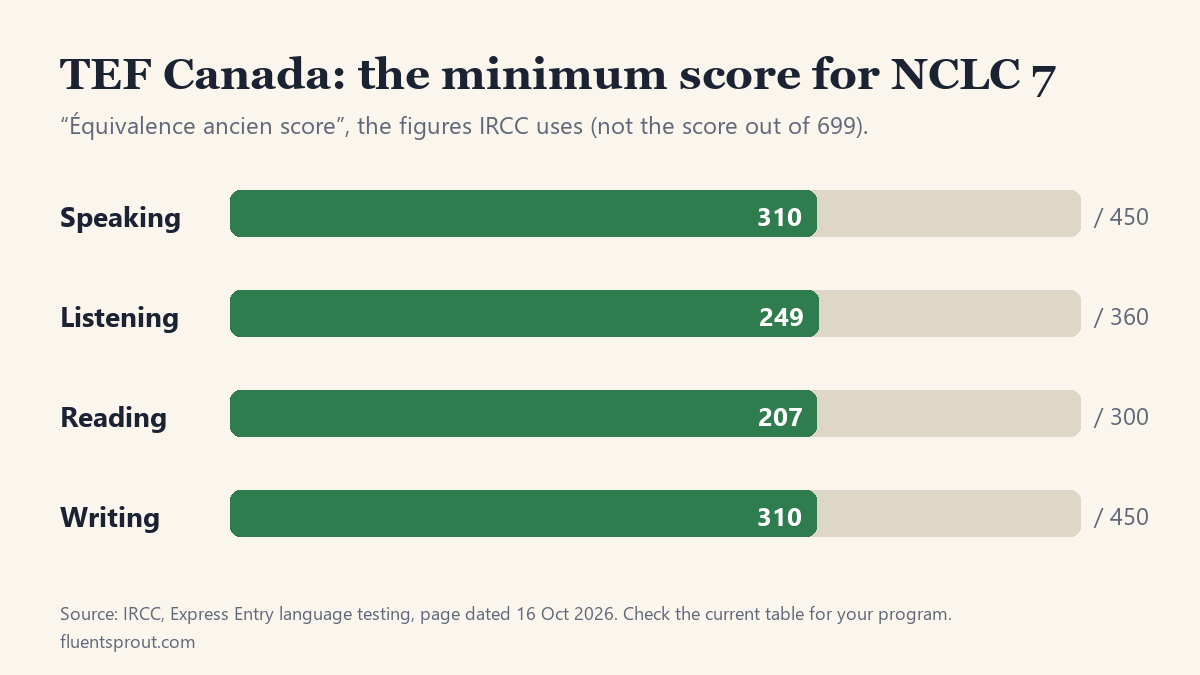
- Speaking: 310 out of 450
- Listening: 249 out of 360
- Reading: 207 out of 300
- Writing: 310 out of 450
The full table for every level is in our TEF and TCF Canada score chart, and the NCLC calculator works out your levels from your scores.
Each skill counts on its own. A great reading score won't make up for a weak speaking score, so plan for your weakest skill.
Strategy, section by section
- Reading and listening: wrong answers cost nothing. Never leave a question blank.
- Listening: read the question and options before the audio starts. Most recordings play only once.
- Writing A: match the article's style and tense, add events in a logical order, and go well past 80 words.
- Writing B: spend 3–4 minutes planning. Write an introduction, two or three arguments with examples, a counter-argument and a conclusion. Linking words such as d'abord, en revanche and par conséquent help.
- Speaking A: prepare your question words in advance (Quand…? Combien…? Est-ce que…?), use the formal vous, and cover price, timing, conditions and place.
- Speaking B: start with the advantages, then answer each objection calmly with an example. Your job is to persuade, not just describe.
How long does it take from zero?
NCLC 7 is roughly comparable to B2 on the European (CEFR) scale. That's an approximation: IRCC scores by NCLC, not CEFR. The US Foreign Service Institute puts French among the languages that take an English speaker about 600–750 class hours to reach professional working proficiency. Self-study varies widely, but at around an hour a day, most adults should plan in months, not weeks. Speaking and writing take the longest, so start practising them early, not in the last month.
A realistic shape for a plan:
- Months 1–3, foundations (A0–A1): sounds, everyday phrases and the present tense. Speak aloud every day.
- Months 3–6, A2: past and future tenses and everyday situations. Start writing short messages.
- Months 6–10, B1: longer listening and opinions. Start practising the TEF task formats.
- The final months, B2 and exam practice: timed mock sections, plus feedback on writing and speaking against the NCLC targets.
Practise with FluentSprout
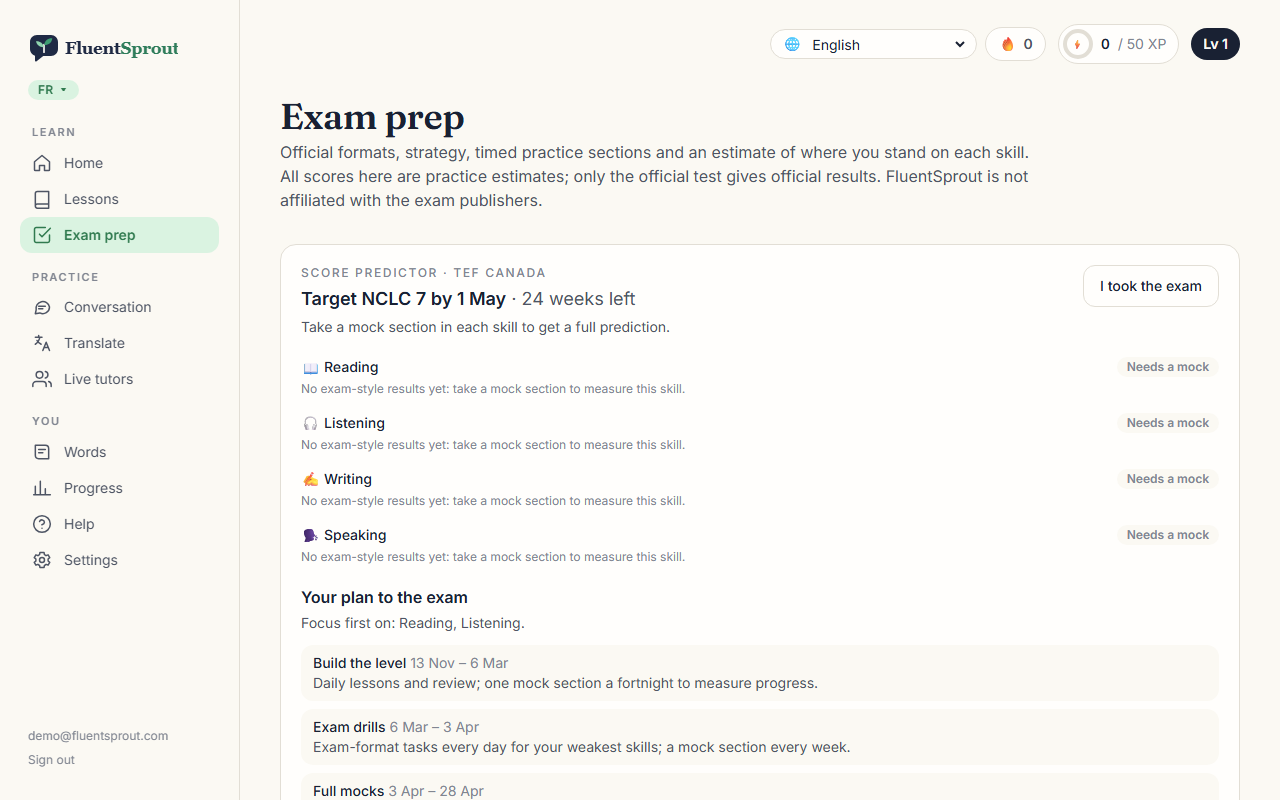
FluentSprout's French course runs from A0 to B2 in 99 lessons, with TEF Canada and TCF Canada exam tracks, timed mock sections and an estimated NCLC level per skill. It's an estimate, not an official score. Set your exam and target date, and the app plans what to study next. The lessons are free.
Exam formats change. Always check the official TEF Canada page and IRCC's language-test page before you book.