
TestDaF vs DSH vs Goethe-Zertifikat: which German test for university?
November 18, 2026 · Updated November 18, 2026

If you want to study a German-taught degree in Germany, you'll need to prove your German. Three certificates come up again and again: TestDaF, DSH and the Goethe-Zertifikat.
The usual requirement
For most programmes, any of these is accepted:
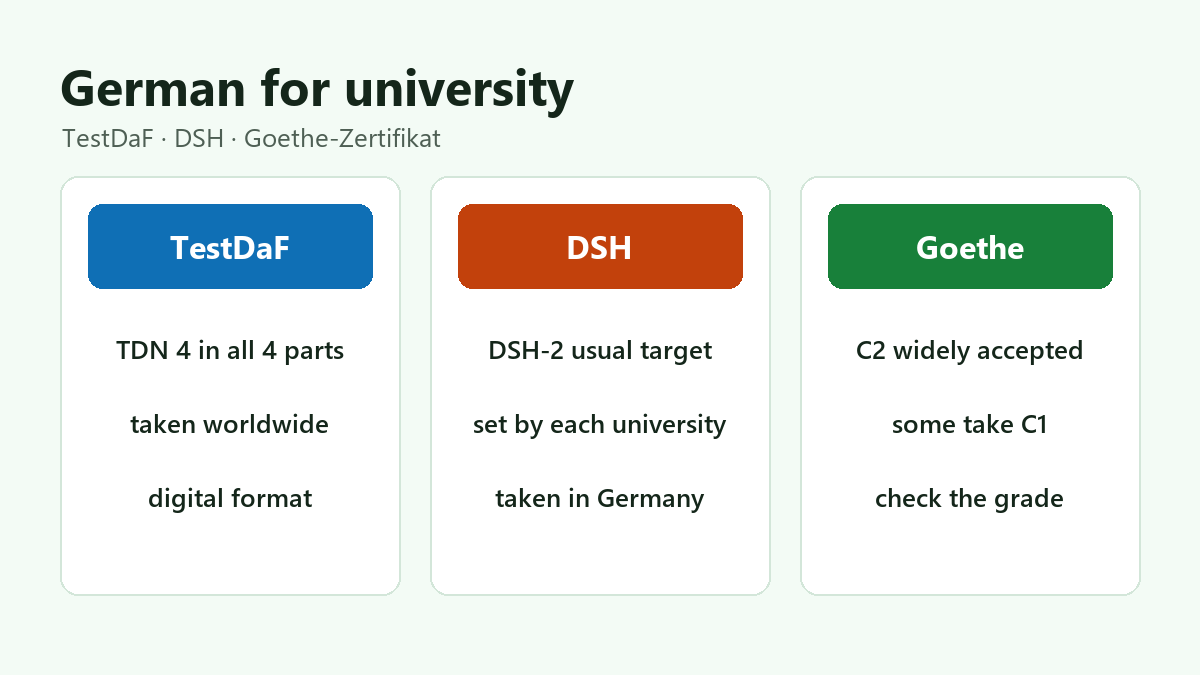
- TestDaF with TDN 4 in all four parts
- DSH-2
- Goethe-Zertifikat C2 (some universities also accept C1, and some ask for a minimum grade)
The exact list is set by each university, and sometimes by each programme, so always check your programme's admissions page.
TestDaF
- A standardised test you can take at test centres around the world, in a digital format.
- It's scored in four parts (reading, listening, writing, speaking) at levels TDN 3, 4 or 5.
- TDN 4 in every part is the common admission level. A few universities allow a TDN 3 in one part balanced by a TDN 5 in another, and a few demanding programmes ask for more.
- Choose it if you want to apply before you arrive, or to several universities at once.

DSH
- Set and marked by each university, and usually taken in Germany shortly before the semester starts.
- Results are DSH-1, DSH-2 or DSH-3. DSH-2 is the usual admission level.
- Choose it if you're already in Germany, for example at a preparatory college, and your target university runs it.

Goethe-Zertifikat
- The Goethe-Institut's general exams, from A1 to C2, offered worldwide.
- C2 is widely accepted for admission, sometimes with a minimum grade, especially for medicine.
- Choose it if you're also using the certificate for work or a visa, or your programme lists it.
How to prepare
All three test academic German: lectures, articles, graphs and structured arguments. Practise summarising a short lecture in writing, describing a chart out loud, and arguing for and against a position on a timer. Do at least one full timed mock in the format you choose.
Related: The Goethe-Zertifikat explained · TestDaF · DSH.