
Can ChatGPT or Gemini teach you a language? Great for the basics, not for fluency
November 15, 2026 · Updated November 18, 2026

Ask ChatGPT or Gemini to teach you Spanish and you'll get a friendly answer in seconds: ten greetings, a pronunciation tip and an offer to quiz you. It feels like having a tutor in your pocket.
For the first few weeks, it nearly is. After that, most learners stall. The reason isn't that the model is bad at languages. It's very good at them. The reason is that a chatbot is built to answer questions, and learning a language isn't a question. It's months of the right practice, in the right order, with someone keeping track.
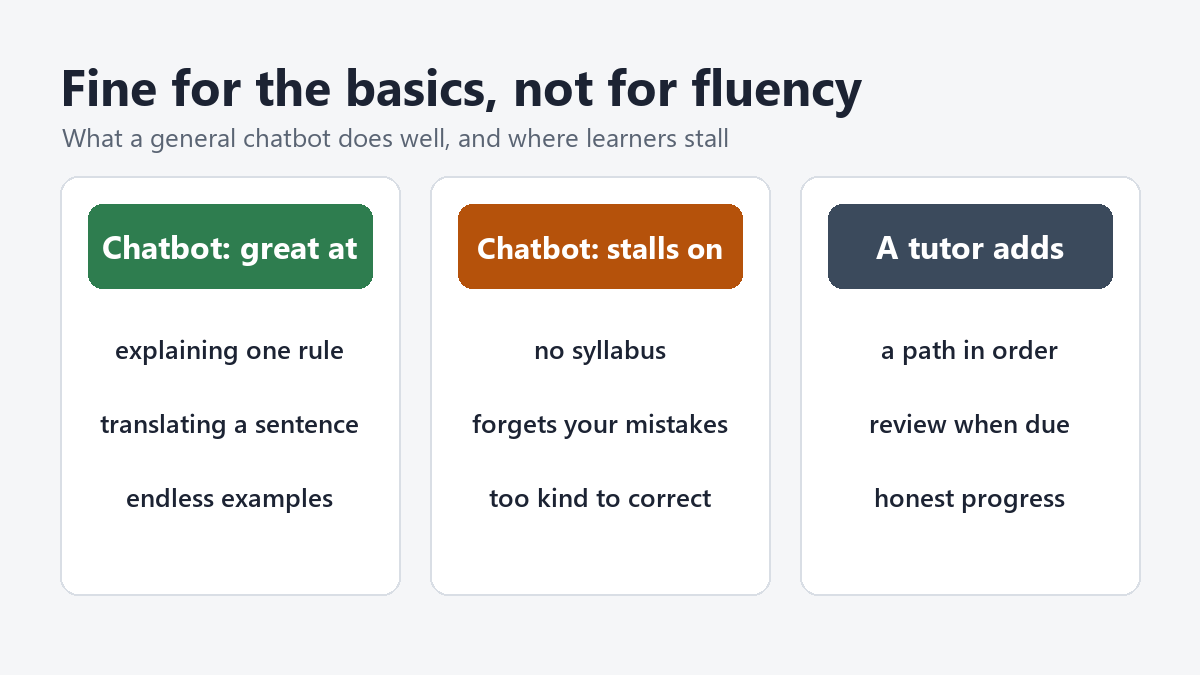
What a chatbot does well
Credit where it's due. A general chatbot is excellent at:
- Explaining one thing. "Why is it la mano and not el mano?" You'll get a clear answer.
- Translating and rephrasing. Paste a sentence, get a natural version back.
- Generating examples. Twenty sentences with the subjunctive, on demand.
- Being patient. It never sighs when you ask the same question a third time.
If you're curious about a language, planning a holiday, or need a quick phrase, that's often all you need.
Where it stalls
1. It has no syllabus

A course decides what you learn next, and it holds back what you aren't ready for. A chatbot does whatever you ask. That sounds like freedom, but it means you are the curriculum designer. Most beginners don't know whether to learn the past tense before object pronouns, or how many words they need before reading a news article. So they ask for "more practice", get a random set of exercises, and circle the same level for months.
2. It doesn't remember your mistakes
Chatbot "memory" stores facts about you: your name, that you're learning German. It doesn't keep a record of the 40 words you got wrong last week and bring them back on day 3, day 7 and day 21 when you're about to forget them. That timed review, called spaced repetition, is one of the best-tested ideas in language learning, and a chat window doesn't do it for you.
3. It's too kind
General chatbots are tuned to be helpful and agreeable. In a language, that means they often let small errors slide, praise sentences a teacher would correct, and change their mind when you push back ("Are you sure? I think my version is right."). A tutor needs to say "no, that's wrong, here's why", every time, consistently.
4. It can be confidently wrong
Large language models occasionally invent a grammar rule, mix up a gender, or blend European and Latin American Spanish in one sentence. An expert spots it. A beginner can't, and that is exactly who is asking.
5. You can't see your progress
After three months of chats, what's your level? Which skill is weakest? Are you on track for your goal? A chat history can't tell you. Without a measure, most people either quit or keep doing what feels comfortable.
6. It doesn't know your exam
If you're aiming for TEF Canada, DELE or the JLPT, you need the exam's real format, real timings and marking against the published criteria. A chatbot will happily write you a "mock exam" and give you a "score", but neither is built to the exam's specification. We cover this in Can you prepare for TEF Canada or DELE with ChatGPT?
So, should you use a chatbot at all?
Yes, as a tool. Use it like a dictionary that talks back: to explain a rule, check a sentence, or translate a menu. Don't use it as your course.

What gets you from basics to fluency is the structure around the AI:
- A path that orders what you learn and won't let you skip what you haven't mastered.
- Review that brings back what you're about to forget.
- Speaking practice that checks what you actually said, at your level.
- Honest measurement: where you are now, and where you're heading.
How FluentSprout is different
FluentSprout uses large language models too. The difference is everything we built around them.
- Lessons in order. Each lesson goes Learn, Practise, Check. You need 80% on the check to open the next one, so every lesson builds on the last. A placement check puts you at the right level on day one.
- A tutor that stays a tutor. Ask the tutor explains an exercise in your own language, but it won't give away answers during a check or an exam.
- Conversation at your level. Under everything you say you see what you said, how to say it correctly and what you meant.
- Review built in. Words you've learned come back when they're due.
- Exam practice in the real format. Timed reading and listening mocks for TEF Canada, TCF Canada, DELE B2 and SIELE, with estimates shown as ranges, never as official scores.
A chatbot can get you started. To get the job done, you need a tutor that knows where you are and what comes next. Start learning with FluentSprout.