
DELF Format and Timing: Complete Exam Breakdown
November 27, 2026 · Updated November 27, 2026
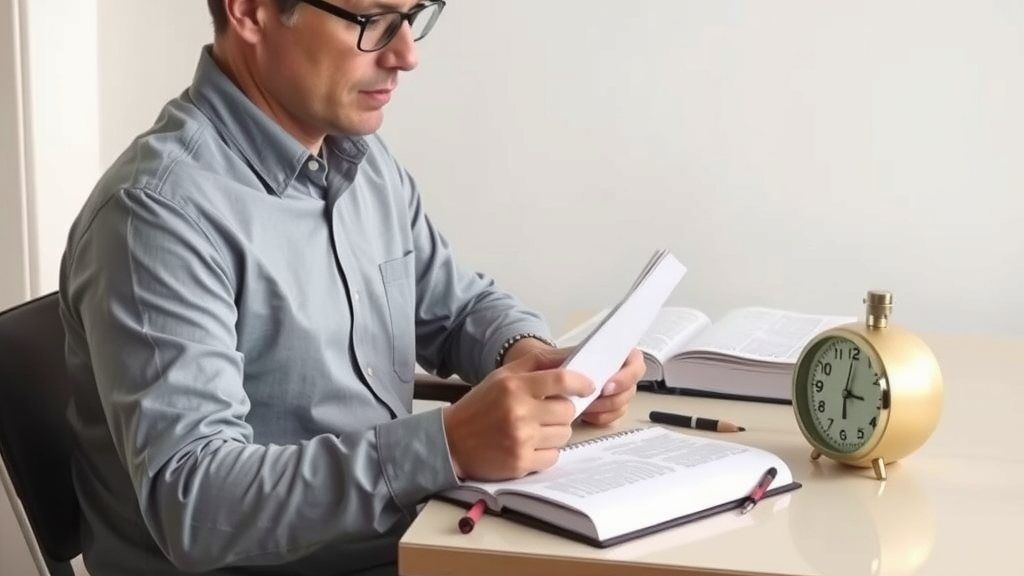
The DELF exam has four sections: listening comprehension, reading comprehension, written production and oral production. Its timing depends on your chosen level (A1, A2, B1 or B2), and you need at least 50 out of 100 points overall, with a minimum of 5 points in every section, to pass.
Understanding the format before you register helps you prepare more effectively. The DELF is not a single examination with one universal timetable: each level has its own requirements, exercises and time limits.
For the official examination information, consult the official DELF page).
DELF exam format at a glance
The DELF tout public is an official French language diploma for adults and older adolescents. It consists of four independent diplomas corresponding to CEFR levels A1, A2, B1 and B2.
Each diploma assesses the same four broad language skills, but the number of exercises and time allowed differ by level.
Here is the available section-by-section breakdown for A2, B1 and B2.
| Section | Questions or tasks | Time | What it measures |
|---|---|---|---|
| Listening comprehension – A2 | 4 exercises | 25 minutes | Understanding spoken French |
| Reading comprehension – A2 | 4 exercises | 30 minutes | Understanding written French |
| Written production – A2 | 2 writing exercises, at least 60 words each | 45 minutes | Written communication in French |
| Oral production – A2 | 3 parts | 6–8 minutes, with 10 minutes preparation | Spoken French |
| Listening comprehension – B1 | 3 exercises | 25 minutes | Understanding spoken French |
| Reading comprehension – B1 | 2 exercises | 45 minutes | Understanding written French |
| Written production – B1 | 1 writing exercise, at least 160 words | 45 minutes | Written communication in French |
| Oral production – B1 | 3 parts | 15 minutes, with 10 minutes preparation | Spoken French |
| Listening comprehension – B2 | 2 exercises | 30 minutes | Understanding spoken French |
| Reading comprehension – B2 | 2 exercises | 1 hour | Understanding written French |
| Written production – B2 | 1 writing exercise, at least 250 words | 1 hour | Written communication in French |
| Oral production – B2 | 2 parts | 20 minutes, with 30 minutes preparation | Spoken French |
The examination also has a particular structure for candidates at the test center. The collective tests take place simultaneously in the same room, while the individual oral examination takes place with two examiners.
Important: The detailed timings above cover A2, B1 and B2. Do not assume that another level follows the same timetable.
1. Listening comprehension: Understand spoken French
Listening comprehension tests your ability to understand spoken French. You need to pay attention to the information communicated, rather than simply recognize individual French words.
The exercise count and duration change with your level.
| Level | Exercises | Duration | Approximate time per exercise |
|---|---|---|---|
| A2 | 4 | 25 minutes | 25 ÷ 4 ≈ 6 minutes |
| B1 | 3 | 25 minutes | 25 ÷ 3 ≈ 8 minutes |
| B2 | 2 | 30 minutes | 30 ÷ 2 = 15 minutes |
These are average time allocations, not official time limits for individual exercises. Use them as planning references rather than assuming every exercise requires equal effort.
What should you prepare for?
Your preparation should focus on understanding spoken French without becoming distracted by unfamiliar vocabulary.
A common preparation trap is trying to translate every word into your native language. This can make it harder to follow the overall meaning.
Instead, practise the following:
- Identify the main subject of a spoken passage.
- Recognize important information and supporting details.
- Listen for changes in the speaker's message.
- Distinguish the main point from less important information.
- Practise understanding spoken French without pausing after every unfamiliar word.
How to manage your listening time
For A2, use approximately six minutes per exercise as a planning reference. For B1, allow approximately eight minutes, and for B2, approximately fifteen minutes.
Do not spend your entire preparation session replaying a difficult passage. Review what you understood, identify the information you missed and practise again with a different original listening exercise.
The objective is to develop comprehension, not simply become familiar with particular recordings.
2. Reading comprehension: Understand written French
Reading comprehension evaluates your ability to understand written French.
The available exercise counts and durations are:
| Level | Exercises | Duration | Approximate time per exercise |
|---|---|---|---|
| A2 | 4 | 30 minutes | roughly equal time per exercise |
| B1 | 2 | 45 minutes | roughly equal time per exercise |
| B2 | 2 | 1 hour | 60 ÷ 2 = 30 minutes |
These calculations provide a simple way to think about pacing. They do not establish official individual exercise deadlines.
What should you prepare for?
Reading in French requires more than recognizing vocabulary. You need to understand how sentences connect and how information is organized.
For practice, work on:
- Reading a passage once to understand its general subject.
- Identifying the main message.
- Finding specific information within a passage.
- Understanding the relationship between sentences.
- Recognizing the purpose of a written communication.
- Using surrounding sentences to interpret unfamiliar expressions.
How to manage your reading time
At A2, approximately seven to eight minutes per exercise is a useful planning reference.
At B1, think in terms of distributing the available section time evenly across the exercises. At B2, allow approximately thirty minutes per exercise.
Avoid spending too long trying to understand a single unfamiliar expression. Return to the overall meaning of the passage and consider what the surrounding information tells you.
For B1 and B2 preparation, practise reading longer passages without stopping after every sentence. Build the habit of identifying the central message before examining individual details.
3. Written production: Demonstrate your writing ability
Written production is where you demonstrate that you can communicate ideas in French through writing.
Unlike listening and reading, this section requires you to produce your own text. The task requirements differ considerably between A2, B1 and B2.
| Level | Exercises | Minimum writing requirement | Duration |
|---|---|---|---|
| A2 | 2 | 60 words per text | 45 minutes |
| B1 | 1 | 160 words | 45 minutes |
| B2 | 1 | 250 words | 1 hour |
The minimum word requirement matters. Your preparation should include writing complete texts that meet the requirement, rather than concentrating exclusively on grammar exercises.
DELF A2 writing
A2 written production consists of two exercises. You must write two texts, each containing at least 60 words.
Your preparation should focus on producing clear, understandable written communication.
Practise organizing your thoughts before writing. Pay attention to sentence construction, vocabulary and basic grammatical accuracy.
One useful exercise is to choose a familiar everyday subject and write a short, structured text in French. Review whether your message is understandable without unnecessary repetition.
DELF B1 writing
B1 written production consists of one exercise. You must write a text of at least 160 words within 45 minutes.
At this level, practise developing an idea rather than simply producing disconnected sentences.
A useful approach is to organize your writing into:
- An opening that establishes the subject.
- A main section that develops your ideas.
- Supporting explanations or examples.
- A closing that completes your message.
During practice, leave time to review your writing. Check whether your ideas follow a logical order and whether your sentences communicate what you intended.
DELF B2 writing
B2 written production consists of one exercise requiring a text of at least 250 words within one hour.
This requires careful planning. Writing a longer text without organizing your ideas can lead to repetition and an unclear argument.
Practise developing a central position, explaining your reasoning and connecting your paragraphs.
Pay attention to:
- Logical organization.
- Clear paragraph structure.
- Appropriate vocabulary.
- Sentence variety.
- Grammatical accuracy.
- Consistency of argument.
How to manage your writing time
For A2, you have 45 minutes for two texts. Divide your preparation around planning, writing and reviewing both texts.
For B1, use the 45 minutes to plan and complete your single text while meeting the minimum word requirement.
For B2, the one-hour writing session should include time to organize your argument, develop the text and review it.
Do not treat the minimum word count as a reason to stop improving your writing. The aim is to communicate clearly while respecting the task requirements.
4. Oral production: Demonstrate your spoken French
Oral production is the individual speaking component of the DELF examination.
Unlike the collective tests, this examination takes place individually with two examiners. It also includes preparation time, which you should treat as an important part of your examination strategy.
The format differs by level:
| Level | Parts | Speaking time | Preparation time |
|---|---|---|---|
| A2 | 3 | 6–8 minutes | 10 minutes |
| B1 | 3 | 15 minutes | 10 minutes |
| B2 | 2 | 20 minutes | 30 minutes |
DELF A2 oral production
A2 oral production consists of three parts. The examination lasts between six and eight minutes, with ten minutes of preparation.
Your preparation should focus on communicating simple ideas clearly and responding without becoming overly concerned about producing perfect sentences.
Practise introducing yourself, expressing basic information and developing short spoken responses.
A useful exercise is to choose a familiar subject, prepare a few key points and explain them aloud in French.
DELF B1 oral production
B1 oral production has three parts and lasts fifteen minutes, with ten minutes of preparation.
Use your preparation time to organize the main ideas you want to communicate.
Rather than memorizing complete answers, practise building responses around a clear structure:
- Introduce the subject.
- Explain your main idea.
- Give supporting reasons.
- Add relevant examples.
- Finish with a clear closing statement.
Practise speaking without relying on a written script. You want to become comfortable expressing ideas naturally.
DELF B2 oral production
B2 oral production has two parts. The speaking examination lasts twenty minutes, and preparation lasts thirty minutes.
The preparation period is an important opportunity to organize your thoughts before speaking.
Develop a structured approach:
- Identify the central subject.
- Decide on your main position.
- Organize supporting arguments.
- Consider possible objections or alternative viewpoints.
- Prepare a logical progression of ideas.
During practice, focus on explaining your reasoning rather than simply speaking for longer.
How to use preparation time effectively
The preparation period should not become an exercise in memorizing sentences.
Instead, create a mental outline that helps you communicate your ideas. Practise speaking from that outline, using complete sentences and appropriate vocabulary.
Record your practice responses if useful. Listening to yourself can help identify unclear explanations, repeated expressions and grammatical mistakes.
DELF scoring: Understand the pass requirements
Knowing the scoring rules is just as important as understanding the examination format.
Each of the four sections is scored out of 25 points, giving a maximum overall score of 100.
| Section | Maximum points |
|---|---|
| Listening comprehension | 25 |
| Reading comprehension | 25 |
| Written production | 25 |
| Oral production | 25 |
| Total | 100 |
To pass, you must satisfy both requirements:
1\. Obtain at least 50 points out of 100 overall. 2\. Obtain at least 5 points out of 25 in every section.
The eliminatory rule is important: A score below 5 points in any individual section results in failure, even if your combined score reaches the overall passing requirement.
For example, a candidate who performs strongly in reading and listening but receives fewer than 5 points in written production does not satisfy the passing requirements.
This is why preparing for all four skills matters.
Do not concentrate exclusively on your strongest section. Your preparation plan should give adequate attention to listening, reading, writing and speaking.
Rules that change how you play
Understanding the examination structure helps you prepare, but it is equally important to distinguish confirmed examination rules from assumptions.
Here is what the available examination information establishes.
Collective tests and individual oral examination
The DELF tout public includes collective tests conducted simultaneously in the same room. The oral examination is individual and involves two examiners.
Prepare for the distinction between completing collective written and comprehension tests and participating in an individual speaking examination.
Section order
The examination information identifies the four sections and distinguishes collective tests from the individual oral examination. It does not establish a universal candidate-facing sequence beyond the sections presented in this guide.
Do not assume that the sequence or scheduling arrangements are identical at every examination session.
Skipping and returning to questions
The available examination information does not specify whether candidates can skip questions, return to previous questions or change answers.
Do not build your preparation around an assumed navigation rule. Check the instructions provided by your examination center.
Adaptivity and difficulty
The available information does not establish that the DELF examination adapts question difficulty according to your previous answers.
Focus on the requirements of your chosen diploma rather than assuming that the examination changes dynamically.
Calculators, tools and breaks
The available information does not establish calculator permissions, permitted personal tools or scheduled breaks.
Check the instructions supplied for your examination session instead of relying on assumptions from other language examinations.
Test center or at home?
The DELF examination information covered here establishes a collective-test arrangement in which candidates take the collective tests simultaneously in the same room. The oral examination is individual and takes place with two examiners.
It does not establish an at-home examination option or provide rules for remote testing.
If you are planning to take the DELF, consult the official examination information and your examination center for the applicable arrangements.
What to do next: Prepare for your DELF level
Your preparation should match the diploma you intend to take.
If you are working towards A2, prioritize building confidence across the four language skills and practising the two written texts.
For B1, give particular attention to the longer reading section, the 160-word writing requirement and the individual speaking examination.
For B2, develop your ability to understand longer reading material, write a structured text of at least 250 words and communicate your arguments during the oral examination.
You can explore the FluentSprout DELF preparation page to find the preparation path for your level.
FluentSprout's DELF preparation in the app: practice in the exam's format, with results shown as practice estimates. Open the app, select Exams, then DELF, to start practising: Start practising in the app.