
Family words in Korean: talk about the people you love
November 16, 2026 · Updated November 18, 2026

"Do you have brothers or sisters?" is one of the first questions anyone asks you in Korean. Here are the words you need to answer, and the details that trip English speakers up.
The words
| English | Korean | Say it |
|---|---|---|
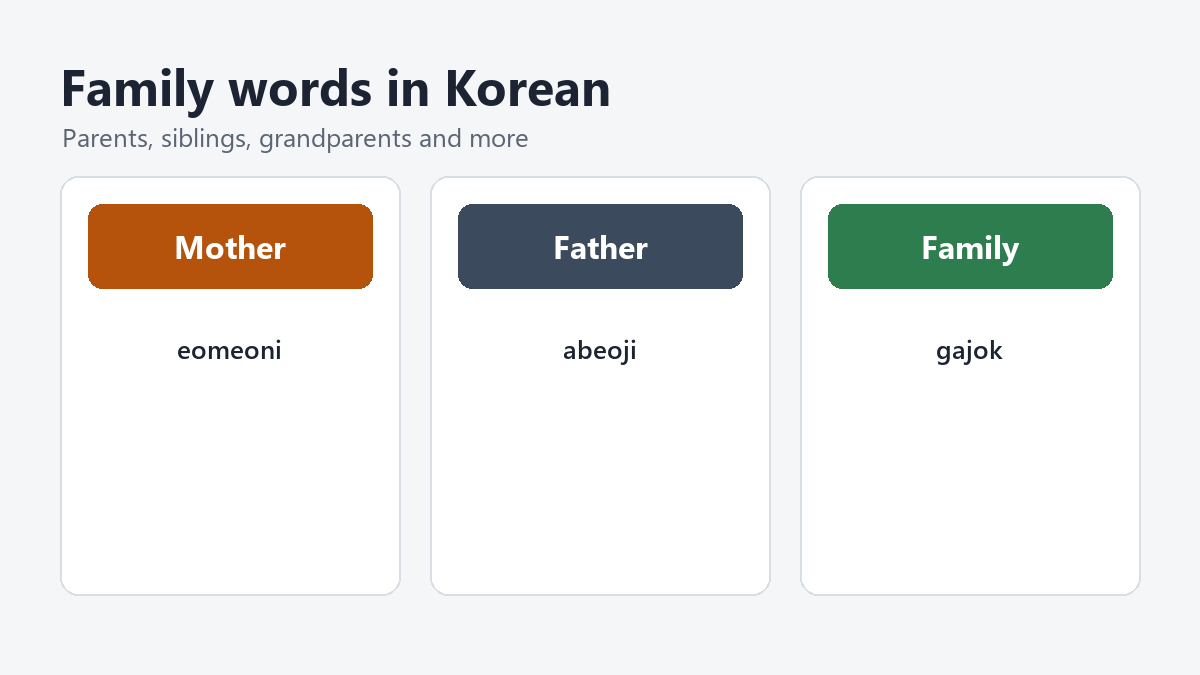
| family | 가족 | gajok |
| mother / mum | 어머니 / 엄마 | eomeoni / eomma |
| father / dad | 아버지 / 아빠 | abeoji / appa |
| parents | 부모님 | bumonim |
| brother | 형 / 오빠 / 남동생 | hyeong / oppa / namdongsaeng |
| sister | 누나 / 언니 / 여동생 | nuna / eonni / yeodongsaeng |
| son | 아들 | adeul |
| daughter | 딸 | ttal |
| grandmother | 할머니 | halmeoni |
| grandfather | 할아버지 | harabeoji |
| husband | 남편 | nampyeon |
| wife | 아내 | anae |
| uncle | 삼촌 | samchon |
| aunt | 이모 / 고모 | imo / gomo |
| cousin | 사촌 | sachon |
What English doesn't tell you
- Older siblings depend on who's speaking: a man calls his older brother hyeong and older sister nuna; a woman says oppa and eonni.
- Younger siblings are dongsaeng, with nam- (male) or yeo- (female) in front.
- Aunts depend on the side: imo is your mother's sister, gomo your father's sister.
Try it: 저는 언니 한 명하고 남동생 한 명이 있어요. (jeoneun eonni han myeonghago namdongsaeng han myeong-i isseoyo.): I have one older sister and one younger brother (said by a woman).
Practise
Describe your own family out loud in Korean: who they are, where they live, what they do. In FluentSprout's Talk, the tutor asks follow-up questions like a new friend would and corrects every sentence.
More Korean: introduce yourself, numbers and colours.
Browse the Korean lessons or start free on FluentSprout.