
IELTS band scores explained: how the 0-9 scale and overall score work
November 23, 2026 · Updated November 13, 2026
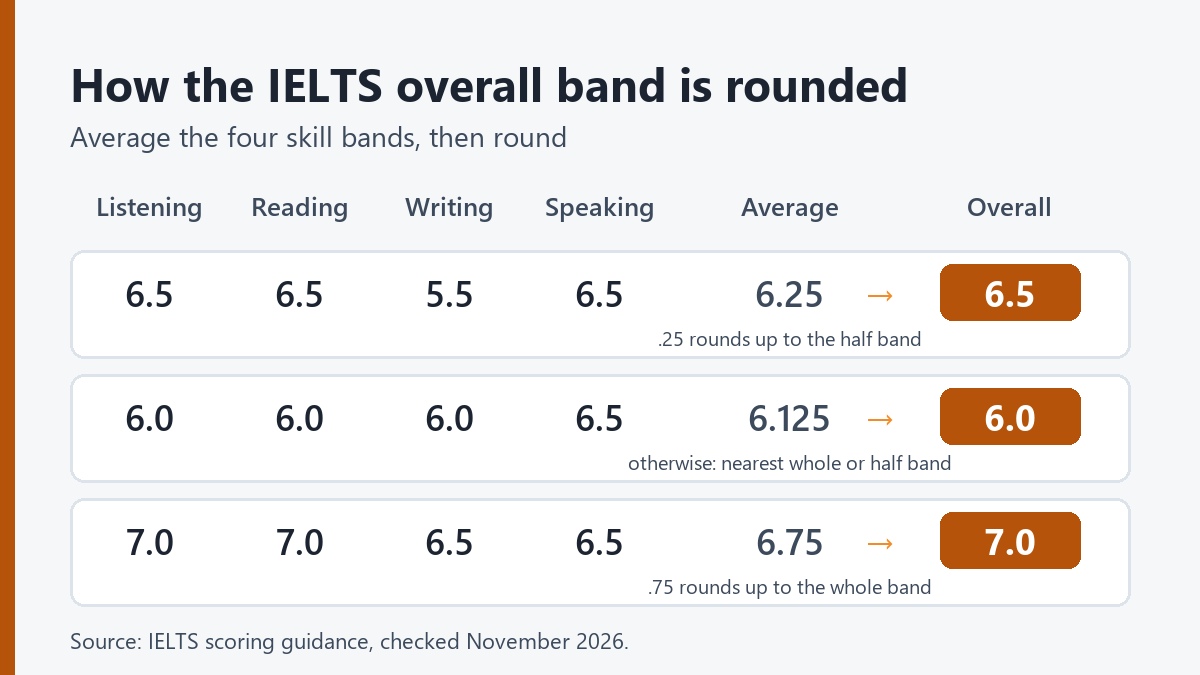
Short answer: IELTS gives a band from 0 to 9, in whole or half bands, for each of listening, reading, writing and speaking. Your overall band is the average of the four, rounded: an average ending in .25 rounds up to the next half band, and one ending in .75 rounds up to the next whole band. So 6.25 becomes 6.5, while 6.125 becomes 6.0.
Facts checked November 2026 against IELTS's official scoring page.
The 0 to 9 scale in plain language
Each band has an official IELTS label:
- 9, Expert user: full, accurate, fluent command.
- 8, Very good user: occasional small errors in unfamiliar situations.
- 7, Good user: handles complex language well, with some mistakes.
- 6, Competent user: effective in familiar situations, with some errors and misunderstandings.
- 5, Modest user: partial command; copes with overall meaning in most situations.
- 4, Limited user: basic competence in familiar situations only.
- 3 to 1, Extremely limited to non-user: very little usable English.
- 0: did not attempt the test.
How the overall band is calculated (with examples)
- Add your four skill bands.
- Divide by four.
- Round: .25 goes up to .5, .75 goes up to the next whole band, and anything else goes to the nearest whole or half band.
Three worked examples (listening, reading, writing, speaking):
- 6.5, 6.5, 5.5, 6.5: average 6.25, overall 6.5.
- 6.0, 6.0, 6.0, 6.5: average 6.125, overall 6.0.
- 7.0, 7.0, 6.5, 6.5: average 6.75, overall 7.0.
Why your lowest skill still matters
Many universities, employers and visa programmes set a minimum for each skill as well as an overall band (e.g. "overall 6.5, no skill below 6.0"). A strong average won't cover one weak skill. Check the exact requirement where you're applying.
How long does it take to move up a band?
No fixed rule. One full band usually takes months of focused practice, and higher bands take longer. Writing and speaking improve more slowly than reading and listening because they need feedback.
Practising with FluentSprout
Practise speaking English with ML speech recognition, which shows which words came through. Keep your vocabulary fresh with smart review. Exam-format practice: see the IELTS page.
Free to start: start with Google.
FluentSprout is independent and not affiliated with IELTS, the British Council, IDP or Cambridge. IELTS is a trademark of its owners. Practice scores are estimates, not official results.