
When AI does everything, what's left for us? Why languages are a skill worth having
November 18, 2026 · Updated November 18, 2026

Every week brings a new headline: AI writes the code, drafts the contract, translates the meeting, answers the customer. It's easy to feel like the floor is moving, and to ask what's still worth learning.
Here's a quiet answer: a second language. Not because AI can't translate (it can, and it's getting better), but because the parts of work that stay human are exactly the parts that run through language.
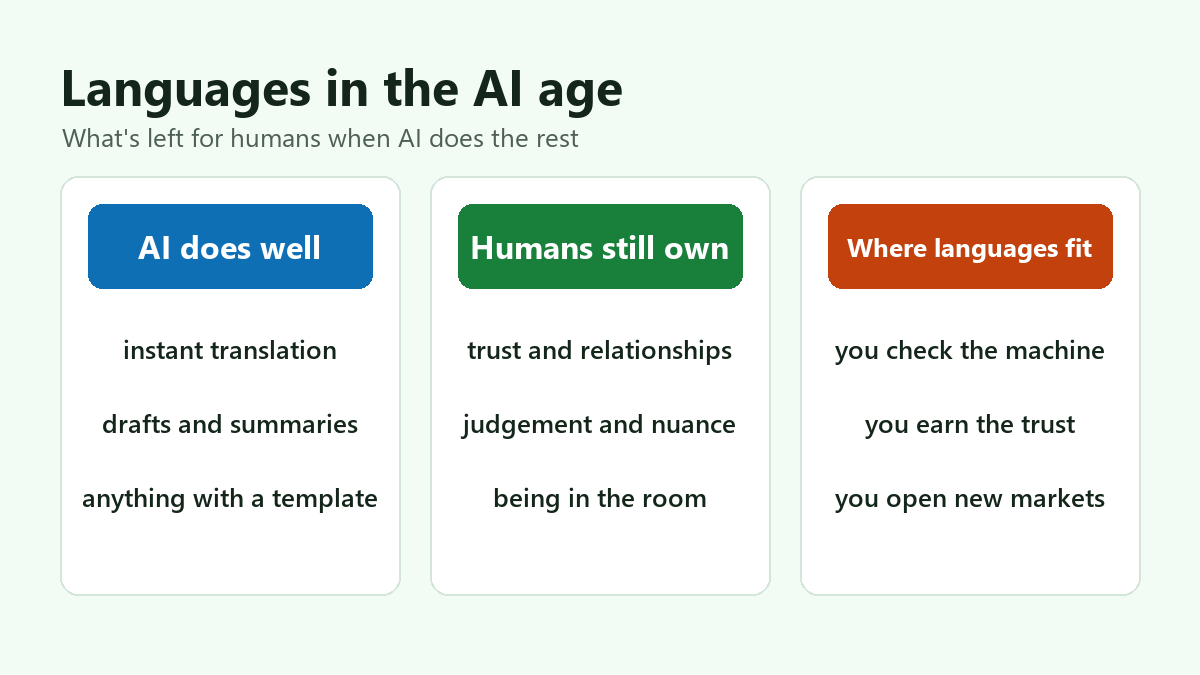
What AI is genuinely good at
- Turning text from one language into another, fast and mostly right.
- Drafting, summarising and rewriting.
- Anything that follows a template and can be checked later.
If your job is only that, it will change. That's real, and pretending otherwise doesn't help anyone.
What stays human
- Trust. People buy from, hire and confide in people they connect with. Speaking someone's language, even imperfectly, signals respect in a way a translation app never will.
- Judgement. Knowing when a polite "yes" means "no", when a joke would land badly, or when a word choice will cause offence in one country and not another.
- Presence. A negotiation over dinner, a nervous patient, a site visit, a job interview. Nobody wants to hold up a phone and wait for the app.
- Checking the machine. If you can't read the language, you can't tell when the AI got it wrong. More on that below.

Languages are a multiplier, not a job title
The strongest position in an AI-heavy world isn't "translator" or "engineer". It's being someone with a real skill plus a second language: a nurse who speaks Spanish, an engineer who can work in German, a support lead who can handle Japanese customers, a sales manager who can open the French-speaking market. AI makes each of these people faster; it doesn't replace what makes them valuable.

Your brain gets something out of it too
Learning a language trains attention, memory and patience: the ability to sit with not understanding until you do. Those habits matter more, not less, when answers arrive instantly.
Where to start
Pick the language that opens a door you actually want: a market, a country, an exam, a family. Then make it daily, even 15 minutes. That's the whole secret.
Read next: Jobs where a second language beats AI · Who checks the AI? Humans with language skills.