
Who checks the AI? Why the future needs humans who speak more than one language
November 18, 2026 · Updated November 18, 2026

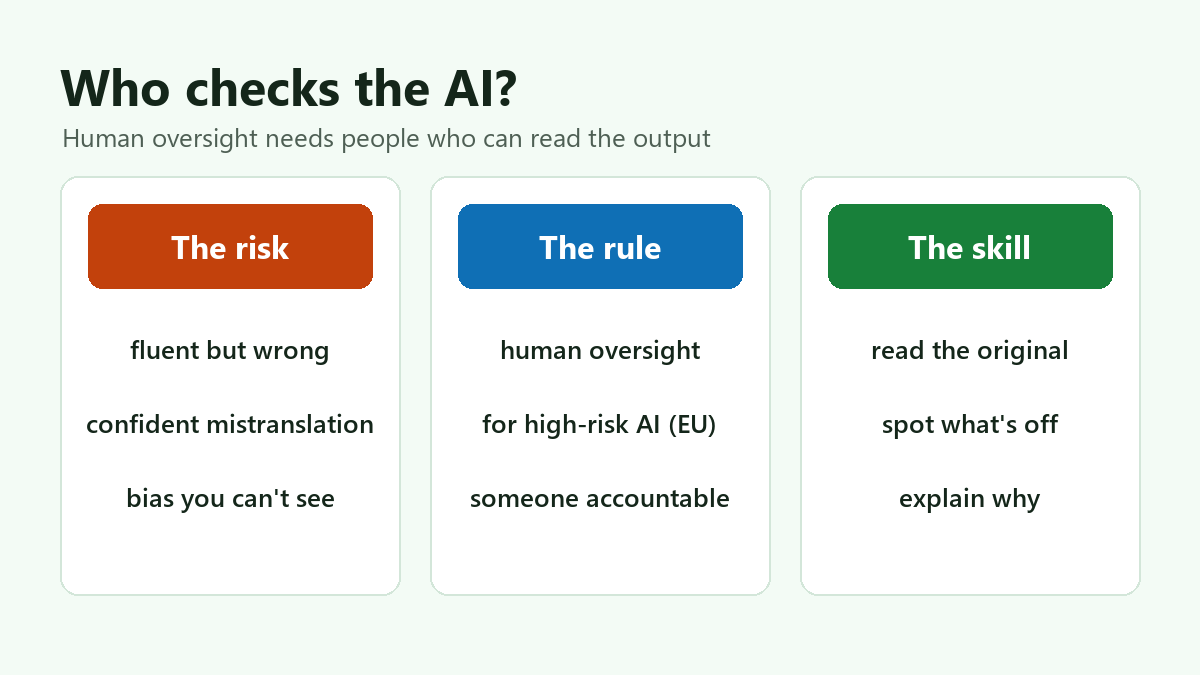
Picture a near future that's already half here: AI agents answer customers in thirty languages, draft contracts for other countries, summarise foreign news for decision-makers and translate medical instructions. Everything sounds fluent. The question nobody asks often enough is: who checks it?
Fluent is not the same as correct
AI output in another language usually sounds right, which is exactly what makes errors hard to spot. Common failures:
- Confident mistranslation: a negation dropped, a number changed, "should" turned into "must".
- Wrong register: too casual for a client, too blunt for a culture that values indirectness.
- Hidden bias: assumptions that read as normal in one language and offensive in another.
- Made-up details: plausible names, dates or sources that don't exist.
If you can't read the language, you can't see any of this. You just ship it.
Oversight is becoming a requirement
Regulators are starting to insist that a person stays responsible. The EU's AI Act, for example, requires human oversight for high-risk AI systems: people who can understand what the system does and step in when it goes wrong. As more AI decisions touch customers, patients and citizens in many languages, organisations need people who can actually read what the AI produced.

What "overseeing AI" looks like in practice
- Reviewing AI answers to customers in their language before or after they go out.
- Spot-checking machine translations of contracts, product information and safety text.
- Testing AI tools for a new market: does it understand local names, dialects and politeness?
- Explaining failures to engineers clearly enough that they can fix them.

You don't need to be a perfect native speaker for much of this. A solid B2 or C1, plus knowing the domain, is often enough to catch the mistakes that matter.
The bigger picture
The more powerful AI becomes, the more valuable the people who can tell when it's wrong. Language is the interface to almost everything AI does. Learning one isn't a nostalgic hobby: it's how you stay the person in charge.
Read next: Jobs where a second language beats AI · Can ChatGPT teach you a language?.