
Which language should I learn next? A free tool that ranks the quickest ones for you
November 23, 2026 · Updated November 23, 2026

"Which language should I learn next?" usually gets answered with someone's favourite: the most spoken, the most useful for business, the most beautiful. Those are fine reasons. But if you want to reach a useful level quickly, the best language for you depends on something more personal: the languages you already know.
That's why we built a free tool: Which language should I learn next?
How it works
You tell it four things:
- Your mother tongue
- Other languages you speak
- Your main goal (for example career, travel or family)
- How many minutes a day you can practise
It ranks the five languages likely quickest for you, with an estimated number of study hours to reach B1 (the CEFR level where you can handle everyday conversations and most travel situations) and a rough timeline at your daily minutes.
It's free, needs no sign-up, uses no AI, and stores nothing: it runs in your browser.
Where the numbers come from
The starting point is the US Foreign Service Institute's language difficulty categories, which estimate the classroom hours English speakers need to reach professional working proficiency (from about 600 to about 2,200 hours depending on the language).
We then:
- take roughly half of those hours as an estimate for B1, a lower level than professional proficiency; and
- adjust for closeness: shared vocabulary (cognates), the same language family, a script you already read, and similar grammar or sounds all make a language quicker for you.
The result is an estimate, not a promise. Real progress depends on how you study, how often, and how much you speak.
An example
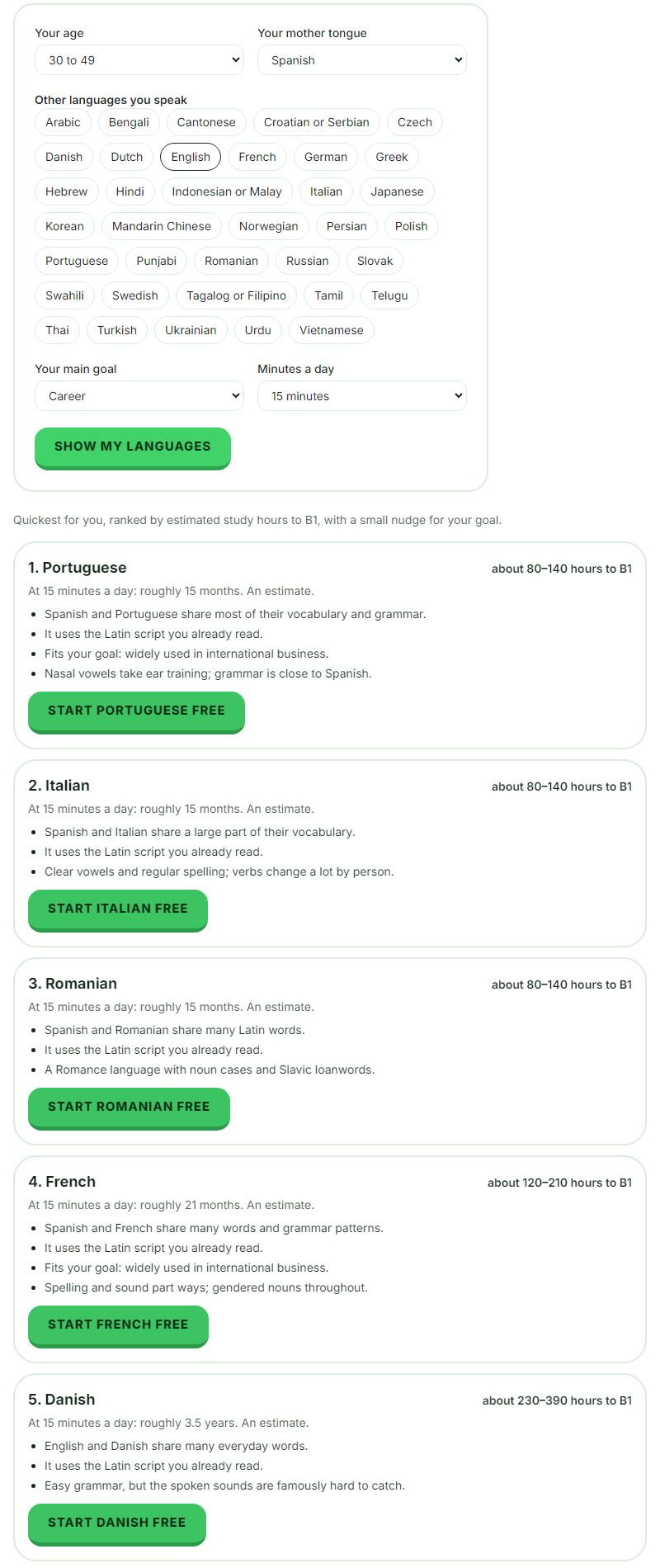
For a Spanish speaker who also speaks English, studying 15 minutes a day, the tool's top suggestions look like this:
- Portuguese: about 80–140 hours to B1. Spanish and Portuguese share most of their vocabulary and grammar; the nasal vowels take some ear training.
- Italian: about 80–140 hours. A large shared vocabulary and clear, regular spelling.
- French: about 120–210 hours. Many shared words and grammar patterns, but spelling and sounds part ways.
Change the mother tongue and the ranking changes completely. A Hindi speaker, a Korean speaker and a Spanish speaker get very different lists.
Some honest notes
- If you don't speak English, the estimates are rougher. The published difficulty data is measured for English speakers, and we adapt it with our own closeness model.
- Age doesn't change the ranking. Adults learn grammar and vocabulary efficiently; what matters most is regular practice.
- "Quickest" isn't the only good reason. If your partner's family speaks Korean or your job is moving to Montréal, learn that language. The tool is for when you're choosing.
Then start
Each result has a button to start that language free in FluentSprout: short daily lessons, speaking practice with AI feedback in every lesson, and a placement check if you already know some.
Find your quickest languages, or read next: how long does it take to learn a language?