
How long does it take to learn a language? Realistic hours by CEFR level
November 20, 2026 · Updated November 20, 2026
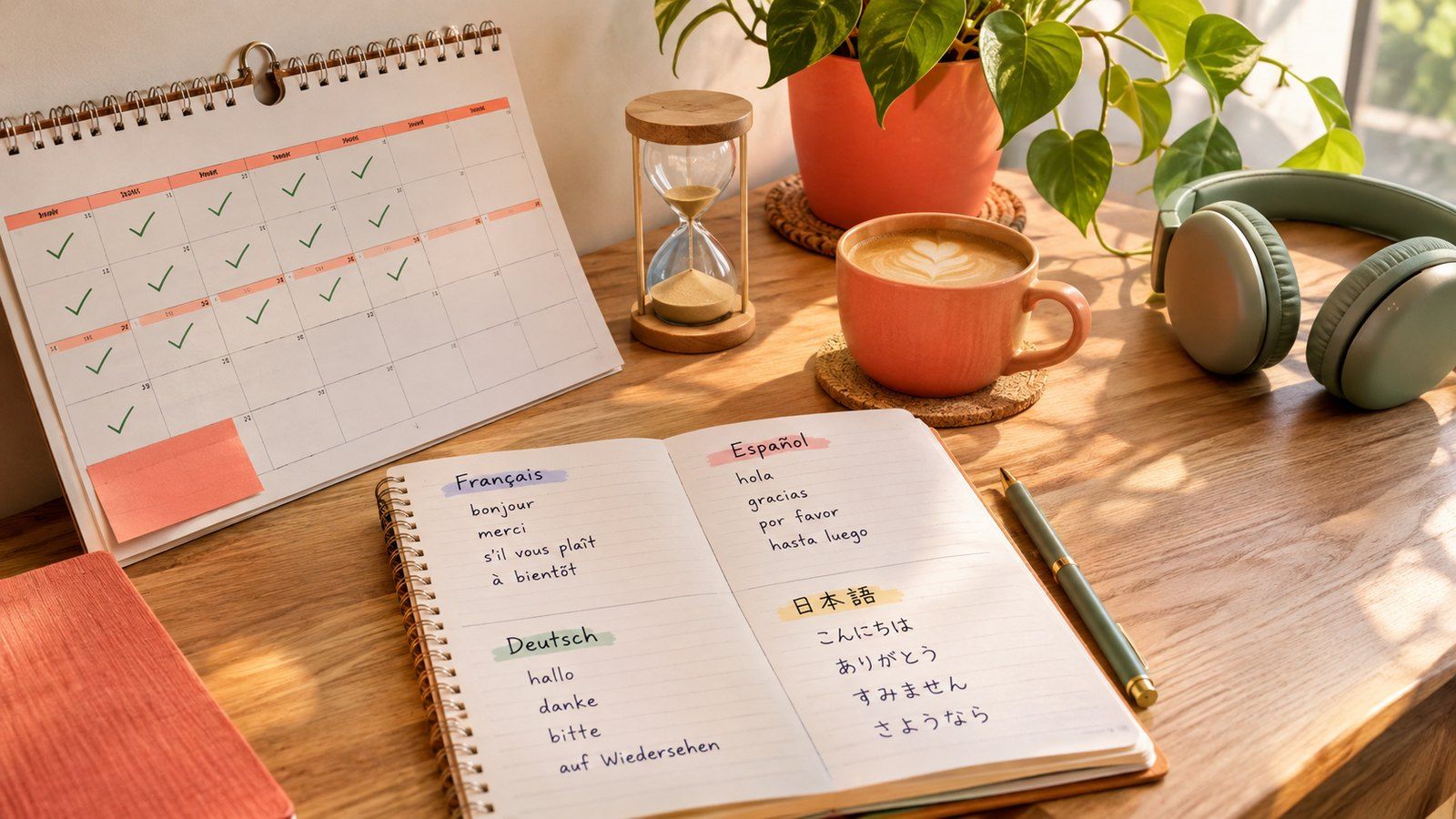
Hey Sprout! "How long will it take?" is the first question almost everyone asks, and most answers online are either vague ("it depends") or suspiciously fast ("fluent in 3 months"). Here are the numbers from two sources that actually measure it, what they do and don't tell you, and how to turn them into a plan.
The short answer
For an English speaker, the US Foreign Service Institute (FSI) expects these times to reach general professional proficiency in speaking and listening: roughly comfortable, accurate conversation on everyday and work topics.
| Language | FSI category | Class time | Class hours |
|---|---|---|---|
| Spanish | I | 30 weeks | about 690 |
| French | I | 30 weeks | about 690 |
| German | II | about 36 weeks | about 828 |
| Japanese | IV | 88 weeks | about 2,200 |
Italian, Portuguese and Dutch sit in Category I at 24 weeks (about 552 class hours). Russian and Turkish are in Category III (about 1,012). Arabic, Korean and Mandarin share Category IV with Japanese.
What those FSI numbers really mean
They are the best public data we have, but read them carefully:
- The goal is high. FSI measures time to level 3 on the Interagency Language Roundtable scale, for speaking and listening together. That's roughly B2 to C1 on the CEFR scale, well past "getting by on holiday".
- The hours are class hours only. FSI's typical week is 23 hours in class plus 17 hours of self-study. So the real effort behind "30 weeks" is closer to 1,200 hours of total work, not 690.
- The learners are a best case. They are full-time adults, often with earlier language experience, taught in small groups by trained teachers. Most of us study part-time, alone, after work.
So treat FSI as a ratio, not a promise: Japanese takes about three times as long as French for an English speaker, and German a little longer than French. That comparison holds up well.
Hours per CEFR level
FSI gives one end point. For the steps in between, the most widely used guide is Cambridge English's guided learning hours: the hours of lessons and supervised study a learner typically needs. They are cumulative, counted from zero:
| CEFR level | What you can do | Guided hours from zero |
|---|---|---|
| A1 | Introduce yourself, order food, simple questions | about 90–100 |
| A2 | Everyday tasks, short simple conversations | about 180–200 |
| B1 | Handle travel, talk about work and plans | about 350–400 |
| B2 | Follow and join real conversations, read the news | about 500–600 |
| C1 | Work and study comfortably in the language | about 700–800 |
| C2 | Near-native precision | about 1,000–1,200 |
Cambridge built these for learners of English, and the gaps grow as you climb: A1 to A2 is about 100 hours, but B2 to C1 is about 200. They line up well with Category I languages like Spanish and French. For German, add a little; for Japanese, Korean or Mandarin, expect a lot more at every level. If you apply the FSI ratio, that's roughly three times, though no official source publishes hours per level for those languages.
What that looks like on a calendar
Here is the arithmetic for reaching the FSI goal, counting class-style hours only:
| Daily study | French or Spanish (690 h) | German (828 h) | Japanese (2,200 h) |
|---|---|---|---|
| 30 minutes | about 3 years 10 months | about 4 years 7 months | about 12 years |
| 1 hour | about 23 months | about 28 months | about 6 years |
| 2 hours | about 12 months | about 14 months | about 3 years |
That looks long, but you don't wait until the end to use the language. At an hour a day, a Category I language gets you to A2 (simple real conversations) in roughly six months, and B1 in about a year.
What changes your number
Some things genuinely speed you up:
- Languages you already know. A Spanish speaker learning Italian, or a Korean speaker learning Japanese, starts far ahead.
- Speaking early and often. Hours of reading don't turn into speaking on their own. If you study alone, here's how to practise speaking with no one to talk to.
- Reviewing on a schedule. Spaced repetition brings words back just before you forget them, so fewer hours are wasted relearning.
- Not skipping ahead. Moving on before a level is solid feels faster and is slower.
And some things don't help as much as they seem to: passive listening with no attention, and apps that only test recognition (picking the right word from four) rather than producing it yourself.
How to plan your own timeline
- Find your starting point. Our free level test takes about 2 minutes, needs no sign-up, and gives you an estimated CEFR range.
- Pick a target level and date. Most travel and social goals need A2 to B1. Work and study usually ask for B2. Many exams state a level too.
- Subtract and divide. Hours to your target minus hours already done, divided by the hours you can honestly study each week.
- Check every few weeks. If you're behind, add a short daily session rather than one long weekend one.
Language by language: French, Spanish, German, Japanese, and the easiest and hardest languages for English speakers.
Start where you actually are
FluentSprout starts you at your level in 47 languages, with lessons that go Learn, Practise and Check, a speaking tutor that corrects every sentence, and reviews timed for memory. Take the free level test, then start learning free.
Sources: US Foreign Service Institute, foreign language training timelines (class weeks and hours to ILR level 3 in speaking and listening; a typical week is 23 class hours plus 17 hours of self-study); Cambridge English, guided learning hours (cumulative hours per CEFR level for English). Calendar figures are our arithmetic from those hours, not a promise: your time depends on your study habits and the languages you already know.