
How long does it take to learn Arabic?
November 15, 2026 · Updated November 18, 2026

Short answer: the US Foreign Service Institute (FSI) puts Arabic in Category IV, at about 2,200 class hours (88 weeks) for an English speaker to reach professional working proficiency. That's roughly B2 to C1 on the CEFR scale.
What that means for you
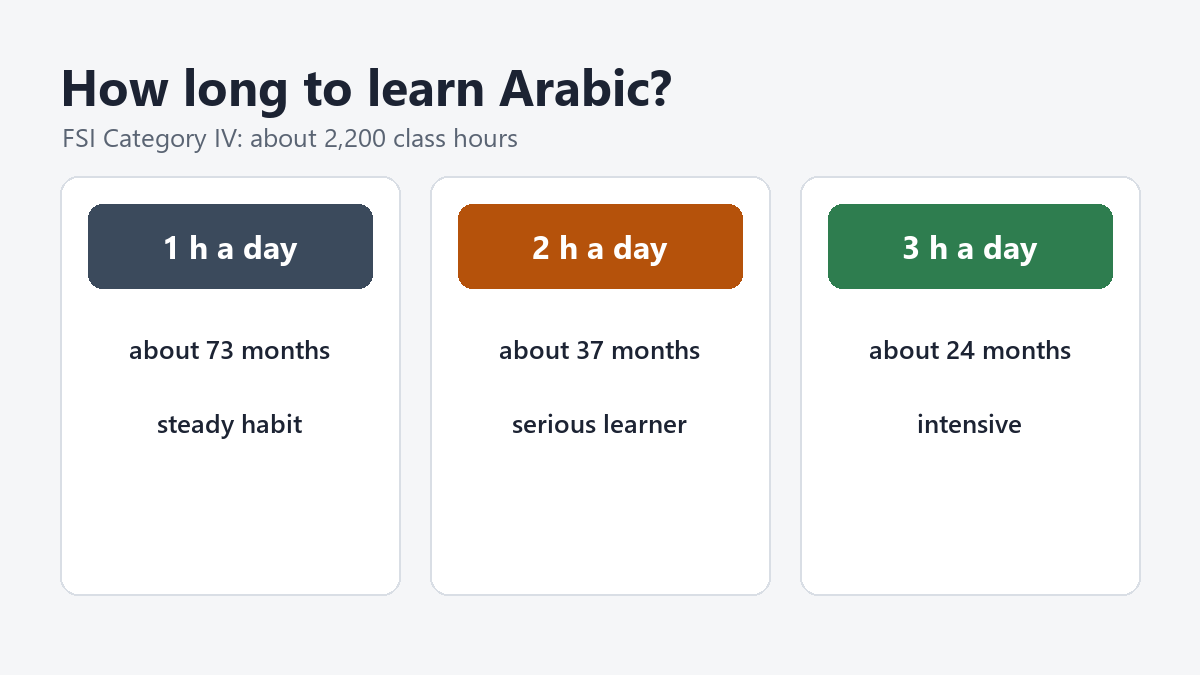
The FSI's hours are full-time classes for motivated adults. Studying on your own, a steady daily habit gets you there in about this long:
| Daily study | Months to about 2,200 hours |
|---|---|
| 1 hour a day | about 73 months |
| 2 hours a day | about 37 months |
| 3 hours a day | about 24 months |
You don't have to wait that long to use it. The first 100 hours or so give you survival conversations (A1–A2), and every hour after that makes real conversations easier.
Compare: the easiest and hardest languages for English speakers.
What makes Arabic easier
- A 28-letter alphabet, and a root system that makes word families easy to guess (k-t-b: write, book, writer).
- Regular, logical verb patterns once you see the system.

What makes Arabic harder
- Right-to-left script with short vowels usually left unwritten.
- Sounds English doesn't have, and the gap between Modern Standard Arabic and spoken dialects.

How to get there faster
- Speak from week one. Hours of reading don't turn into speaking on their own. Talk every day, even for five minutes, and get corrected.
- Review on a schedule. Spaced repetition brings words back just before you forget them.
- Don't skip ahead. Master each lesson before you move on. FluentSprout's 80% gate makes sure you do.
- Listen to real speech with the transcript hidden, then check it.
Learn Arabic on FluentSprout
FluentSprout takes you from zero with a placement check, lessons that go Learn, Practise and Check, conversation with corrections on every sentence, and explanations in your own language whenever you're stuck.
Our course teaches Modern Standard Arabic, the Arabic of news, books and formal speech.
New to Arabic? Start with learn Arabic from zero.
Source: US Foreign Service Institute language difficulty rankings. Hours are FSI class-hour estimates for English speakers, not a promise. Your time will depend on your study habits and the languages you already know.