
Working abroad: why AI translation won't get you hired (but a language will)
November 18, 2026 · Updated November 18, 2026

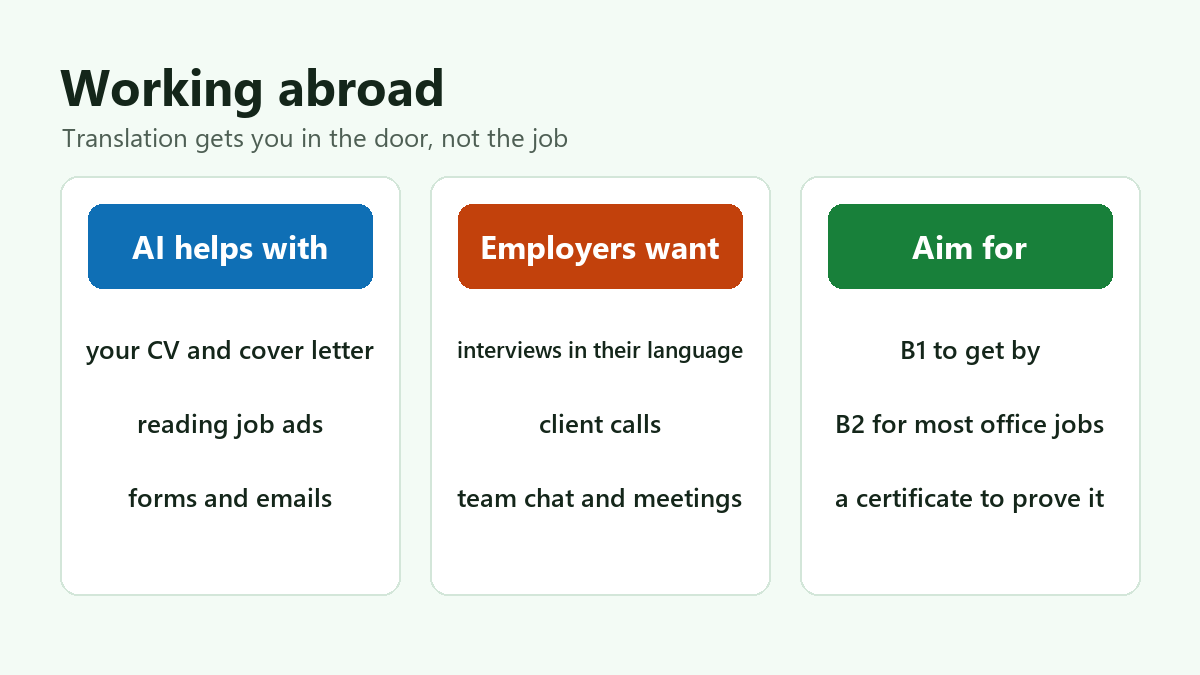
More people than ever plan to work in another country, and AI makes the first steps easier: it can translate job ads, polish a CV and draft a cover letter in a language you don't speak.
Then you get the interview.
Where translation stops helping
- The interview is live, often with several people, and they're judging how you'd fit in the team, not only what you know.
- The job itself runs on meetings, phone calls, quick chats and client conversations that won't wait for an app.
- Trust builds faster with colleagues who can joke with you, ask you a quick question in the corridor and understand you the first time.
For many roles, especially client-facing ones, the language isn't a bonus; it's part of the job description.
The levels employers usually mean
- B1: you can handle everyday work situations, simple meetings and routine emails. Enough to get by in many technical roles in an international team.
- B2: you can take part in meetings, argue a point and write clearly. The common requirement for office jobs and many visas or study programmes.
- C1: you can work fully in the language, including complex documents and negotiations. Expected for many client-facing and professional roles.

A recognised certificate (TEF or TCF for French and Canada, DELE for Spanish, Goethe or TestDaF for German, JLPT for Japanese, TOPIK for Korean) turns "I speak some" into something an employer can check.
How long it takes
From zero, B1 is often around 350 to 400 hours of study and B2 around 500 to 800 for European languages like French or Spanish, and considerably more for Japanese, Korean or Chinese. An hour a day gets most people to B2 in a European language in under two years.

Use AI for the paperwork, learn the language for the job
Let AI help with the CV, the forms and reading the job ads. Spend your own time on the part that gets you hired and keeps you there: speaking, listening and handling real conversations.
Related: How many hours to B2 · How many Express Entry points French is worth.
Also in this series: Why languages matter in the AI age · Jobs where a second language beats AI · Who checks the AI?